Bassoon Fingering Chart
Interactive fingering demonstration + beginner learning guide + free PDF download
Interactive Bassoon Fingering Chart
🎵 How to Use This Interactive Chart
Step 1: Choose Key Signature
Select your desired key signature from the dropdown menu. This will show you which notes are sharp or flat in that key.
Step 2: Click on a Note
Click any note button below to see the correct key fingering. The bassoon diagram will highlight the keys you need to press.
Step 3: Learn the Fingering
Study the highlighted keys on the bassoon and read the fingering description. Practice until it becomes automatic!
Select a Note
Bassoon Fingering Chart Image (PRINTABLE)
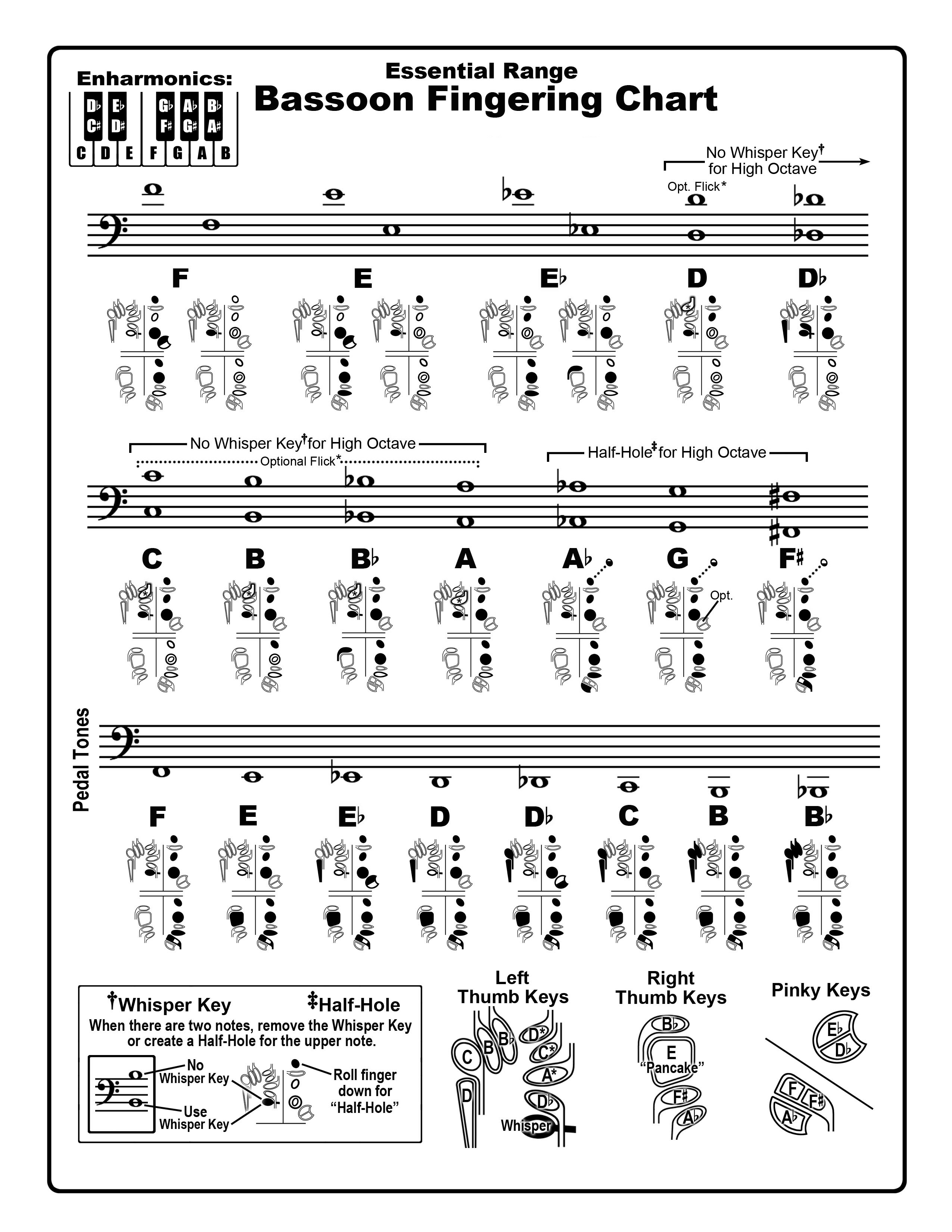
High-quality bassoon fingering chart perfect for practice and reference Download PDF
📚 Complete Bassoon Fingering Guide
For a comprehensive deep-dive into bassoon fingerings, register breaks, and advanced techniques, check out our detailed guide:
BEGINNER BASSOON FINGERING CHART
(Standard Bassoon | German System)
1. Basic Fingering Combinations (Lower-Mid Register)
| Note | Left Hand | Right Hand | Thumb Keys | Description |
|---|---|---|---|---|
| Bb2 | L1, L2, L3, L4 | R1, R2, R3 | T1, T2 | All left, first 3 right + both thumbs |
| C3 | L1, L2, L3, L4 | R1, R2 | T1, T2 | All left, first 2 right + both thumbs |
| D3 | L1, L2, L3, L4 | R1 | T1, T2 | All left, first right + both thumbs |
| E3 | L1, L2, L3, L4 | - | T1, T2 | All left fingers + both thumbs |
| F3 | L1, L2, L3 | - | T1, T2 | First 3 left + both thumbs |
| G3 | L1, L2 | - | T1, T2 | First 2 left + both thumbs |
| A3 | L1 | - | T1, T2 | First left finger + both thumbs |
| Bb3 | L1, L2, L3, L4 | R1, R2, R3 | T1, T2 | All left, first 3 right + both thumbs |
Tip: Always use both thumb keys (T1 and T2) for proper support and tone quality.
2. Essential Beginner Scales
Practice these scales to develop finger dexterity and smooth transitions in the bassoon's comfortable range.
F Major Scale
F3 (T1, T2, L1, L2, L3) - G3 (T1, T2, L1, L2) - A3 (T1, T2, L1) - Bb3 (T1, T2, L1, L2, L3, L4, R1, R2, R3) - C4 (T1, T2, L1, L2, L3, L4, R1, R2) - D4 (T1, T2, L1, L2, L3, L4, R1) - E4 (T1, T2, L1, L2, L3, L4) - F4 (T1, T2, L1, L2, L3)
Bb Major Scale
Bb3 (T1, T2, L1, L2, L3, L4, R1, R2, R3) - C4 (T1, T2, L1, L2, L3, L4, R1, R2) - D4 (T1, T2, L1, L2, L3, L4, R1) - Eb4 (T1, T2, L1, L2, L3, L4) - F4 (T1, T2, L1, L2, L3) - G4 (T1, T2, L1, L2) - A4 (T1, T2, L1) - Bb4 (T1, T2, L1, L2, L3, L4, R1, R2, R3)
C Major Scale
C3 (T1, T2, L1, L2, L3, L4, R1, R2) - D3 (T1, T2, L1, L2, L3, L4, R1) - E3 (T1, T2, L1, L2, L3, L4) - F3 (T1, T2, L1, L2, L3) - G3 (T1, T2, L1, L2) - A3 (T1, T2, L1) - B3 (T1, T2, L1, L2, L3, L4, R1, R2, R3) - C4 (T1, T2, L1, L2, L3, L4, R1, R2)
3. Simple Practice Melodies
(Great for applying new fingerings!)
"Hot Cross Buns":
Bb3 (T1, T2, L1, L2, L3, L4, R1, R2, R3) - A3 (T1, T2, L1) - G3 (T1, T2, L1, L2)
G3 (T1, T2, L1, L2) - G3 (T1, T2, L1, L2) - G3 (T1, T2, L1, L2) - G3 (T1, T2, L1, L2)
A3 (T1, T2, L1) - A3 (T1, T2, L1) - A3 (T1, T2, L1) - A3 (T1, T2, L1)
Bb3 (T1, T2, L1, L2, L3, L4, R1, R2, R3) - A3 (T1, T2, L1) - G3 (T1, T2, L1, L2)
"Mary Had a Little Lamb":
E3 (T1, T2, L1, L2, L3, L4) - D3 (T1, T2, L1, L2, L3, L4, R1) - C3 (T1, T2, L1, L2, L3, L4, R1, R2) - D3 (T1, T2, L1, L2, L3, L4, R1) - E3 (T1, T2, L1, L2, L3, L4) - E3 (T1, T2, L1, L2, L3, L4) - E3 (T1, T2, L1, L2, L3, L4)
D3 (T1, T2, L1, L2, L3, L4, R1) - D3 (T1, T2, L1, L2, L3, L4, R1) - D3 (T1, T2, L1, L2, L3, L4, R1)
E3 (T1, T2, L1, L2, L3, L4) - G3 (T1, T2, L1, L2) - G3 (T1, T2, L1, L2)
4. Bassoon Fingering Tips for Beginners
- Always use a seat strap to support the bassoon's weight - this is essential for proper technique.
- Form a proper embouchure: place the double reed between your lips, not too tight or too loose.
- Keep fingers curved and close to the keys for quick, efficient movement.
- Ensure all tone holes are completely covered to avoid airy or squeaky sounds.
- Use both thumb keys (T1 and T2) consistently for proper support and tone quality.
- Practice long tones to develop a consistent, clear sound and breath control.
- Breathe deeply from your diaphragm - bassoon requires substantial air support.
- Start slowly with a metronome and gradually increase tempo.
- Listen carefully to your tone and intonation - use a tuner regularly, especially in the low register.
- Maintain your double reeds properly - they need to be moistened and cared for regularly.
- Clean your bassoon regularly, especially after each practice session.
- Master the transition between registers - the break between notes can be challenging.
- Develop proper posture - sit up straight with the instrument supported by the seat strap.
- Be patient - bassoon is a complex instrument that requires time and consistent practice.
Understanding the Bassoon Fingering
🔗 Related Instrument
The bassoon is the standard double reed woodwind instrument. For the larger, lower-pitched version, check out our Contrabassoon Fingering Chart.
Bassoon Anatomy and Parts
Before learning fingerings, familiarize yourself with the bassoon's components. The bassoon is a large double-reed woodwind instrument with a complex key system.
Key Components:
- Wing Joint: Upper section containing left hand keys
- Bass Joint: Lower section containing right hand keys
- Bell: Flared end that projects sound
- Bocal: Curved metal tube connecting reed to instrument
- Reed: Double reed that vibrates to create sound
- Keys and Pads: Complex system of approximately 25-30 keys
- Thumb Rest: Supports the weight of the instrument
How the Bassoon Works
The bassoon produces sound when air is blown through the double reed, creating vibrations inside the long conical tube. The instrument's large size and complex key system allow it to produce deep, rich tones across a wide range. By opening and closing keys, you change the effective length of the vibrating air column, producing different pitches.
🎼 New to the Bassoon?
Just starting your bassoon journey? Our comprehensive guide covers everything from embouchure to reed care:
Understanding Musical Notes
Musical notes are the building blocks of music. The bassoon uses the same note names as other instruments but sounds in the bass register.
Want a deeper primer? Read our Music Notes Guide for beginners.
The Musical Alphabet:
- Seven natural notes: A, B, C, D, E, F, G
- Five sharps/flats: A♯/B♭, C♯/D♭, D♯/E♭, F♯/G♭, G♯/A♭
- 12 total pitches in Western music (chromatic scale)
- Bassoon range: Bb1 to E5 (approximately 3.5 octaves)
Half Steps and Whole Steps
Understanding intervals is crucial for mastering bassoon fingerings and music theory.
Half Step (Semitone):
- The smallest interval in Western music
- Example: C to C♯ or E to F
- On piano: distance between adjacent keys
Whole Step (Tone):
- Two half steps combined
- Example: C to D or F to G
- Skips one key on the piano
Bassoon Range and Registers
The bassoon has a range of approximately 3.5 octaves, from Bb1 to E5. Its deep, rich tone makes it essential for orchestral and band music, providing the bass voice in the woodwind section.
Bassoon Range:
- Lowest note: Bb1 (written Bb1)
- Highest common note: E5 (written E5)
- Total span: About 3.5 octaves
- Sweet spot: C3-G4 (most comfortable range)
Common Bassoon Fingering Patterns Chart
Here are fundamental fingering patterns to get you started. Mastering these will build a solid foundation.
| Note | Fingering/Position |
|---|---|
| Bb2 | Left thumb + first 3 fingers, right first 3 fingers |
| C3 | Left thumb + first 3 fingers, right first 2 fingers |
| D3 | Left thumb + first 3 fingers, right first finger |
| E3 | Left thumb + first 3 fingers |
| F3 | Left thumb + first 2 fingers |
| G3 | Left thumb + first finger |
| A3 | Left thumb only |
| Bb3 | Left thumb + register key |
How to Hold the Bassoon Correctly
Proper bassoon holding technique is crucial for developing good tone, technique, and preventing fatigue. The bassoon is held diagonally across the body with support from a seat strap or neck strap.
For a comprehensive guide on proper bassoon holding technique, posture, and advanced positioning methods, check out our detailed Complete Bassoon Fingering Guide.
Key points for proper bassoon holding technique:
- Seat Strap: Essential for supporting the instrument's weight
- Left Hand Position: Left hand supports the wing joint, thumb operates keys
- Right Hand Position: Right hand supports the bass joint, fingers curve over keys
- Bocal Placement: Bocal should be at comfortable angle for embouchure
- Posture: Sit up straight with shoulders relaxed and level
- Arms: Elbows slightly away from body, wrists relatively straight
- Balance: Distribute weight evenly between seat strap and hands
How to Learn to Play the Bassoon
- Start with basics: Learn proper posture, hand position, and sound production
- Master the reed: Learn to make and maintain double reeds
- Practice scales: Build finger dexterity and note recognition in all registers
- Use this chart: Reference fingerings until they become automatic
- Play simple melodies: Apply fingerings in musical context
- Control your air: Bassoon requires steady, controlled air support
- Develop your ear: Intonation is critical on bassoon
- Listen actively: Study professional bassoon recordings
- Be patient: Consistent daily practice yields best results
- Find a teacher: Professional guidance is essential for bassoon
Best Beginner Bassoon Brands and Models
Quality student bassoons from trusted manufacturers make learning easier and more enjoyable:
- Fox Model 41: Excellent student model with good intonation ($8,000-12,000)
- Yamaha YBS-62: Reliable intermediate model ($6,000-9,000)
- Puchner Model 23: Solid student choice with good tone ($7,000-10,000)
- Moosmann M24: Excellent beginner model with consistent quality ($8,000-11,000)
- Schreiber S16: Budget-friendly option for beginners ($5,000-7,000)
Practice Tips
- Warm up properly: Start with long tones in comfortable register
- Practice scales daily: All major and minor scales build technique
- Use a metronome: Develop steady rhythm and timing
- Record yourself: Identify areas for improvement
- Control dynamics: Practice playing softly to develop control
- Check tuning: Use a tuner to develop good intonation
- Short, focused sessions: 30-45 minutes is better than one long session
Common Mistakes to Avoid
- Poor reed care: Neglecting reed maintenance affects tone quality
- Incorrect embouchure: Lips too tight or too loose affects sound
- Poor posture: Slouching restricts breathing and affects tone
- Rushing technique: Playing too fast before mastering basics
- Ignoring maintenance: Regular cleaning and servicing is essential
- Inconsistent practice: Regular short sessions better than irregular long ones
- Poor air support: Weak air stream produces weak, unfocused tone