
Marching Baritone Fingering Chart
Interactive notes fingerings • field posture & projection • downloadable PDF
Interactive Marching Baritone Fingering Chart
🛠️ How to Use This Chart (Field‑Ready)
Step 1: Set Key Signature
Choose the music key to visualize sharps/flats for your show.
Step 2: Select a Note
Click a written note to see its valve combination and staff display.
Step 3: Marching Intonation
Check tendencies with a tuner. Align horn level; project through the arc of the ensemble.
Select a Note (BB♭ Marching Baritone)
Marching Baritone Fingering Chart Image
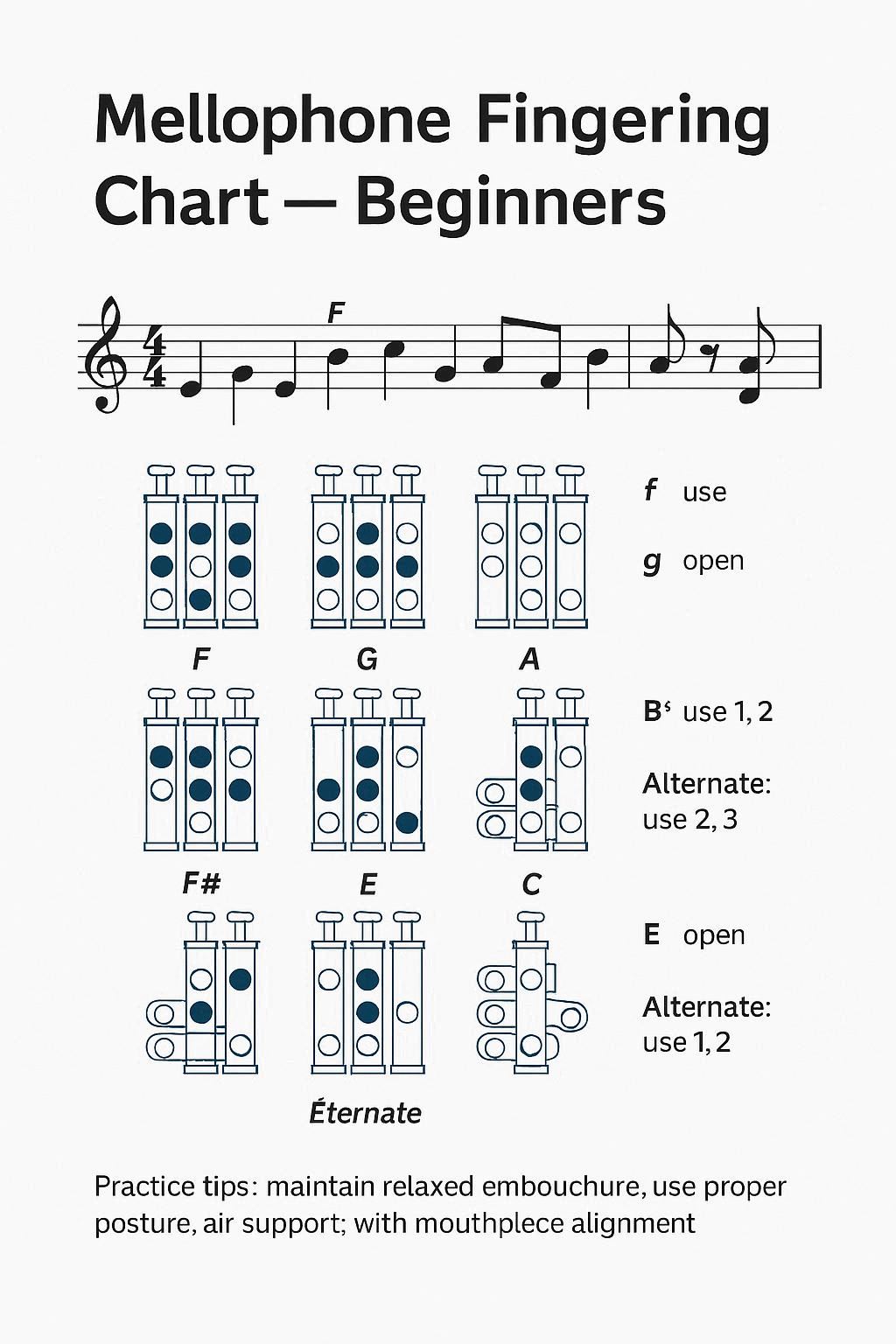
High‑contrast PDF for rehearsals and field reference. Go to Download Page or open PDF directly: Open PDF
🎶 Clef and Transposition
Many marching arrangements use treble‑clef Bb transposed parts (written C sounds Bb). This page displays concert pitch in bass clef to standardize learning; adapt fingerings mentally for treble parts.
New to notation? Read our Music Notes Guide.
Understanding the Marching Baritone
Marching Baritone Anatomy and Parts
Built for projection and balance on the move, the marching baritone features a forward‑facing bell, compact wrap, and 3 piston valves. Compared with concert baritone/euphonium, it emphasizes clarity, attack, and focused tone across the field.
- Mouthpiece: Shallower than euphonium for quicker response and projection
- Leadpipe & Valve Block: Straightforward alignment for efficient airflow
- Valves (3): 1≈whole step, 2≈half step, 3≈minor third; combo extends tubing
- Slides: Tuning adjustments; keep clean and well‑lubricated
- Bell: Forward projection to the audience side
How Marching Baritone Valves Change Pitch
Pressing valves lengthens tubing to lower pitch. Combine valves for chromatic movement. Maintain consistent air and centered embouchure to stabilize intonation when moving and changing directions on the field.
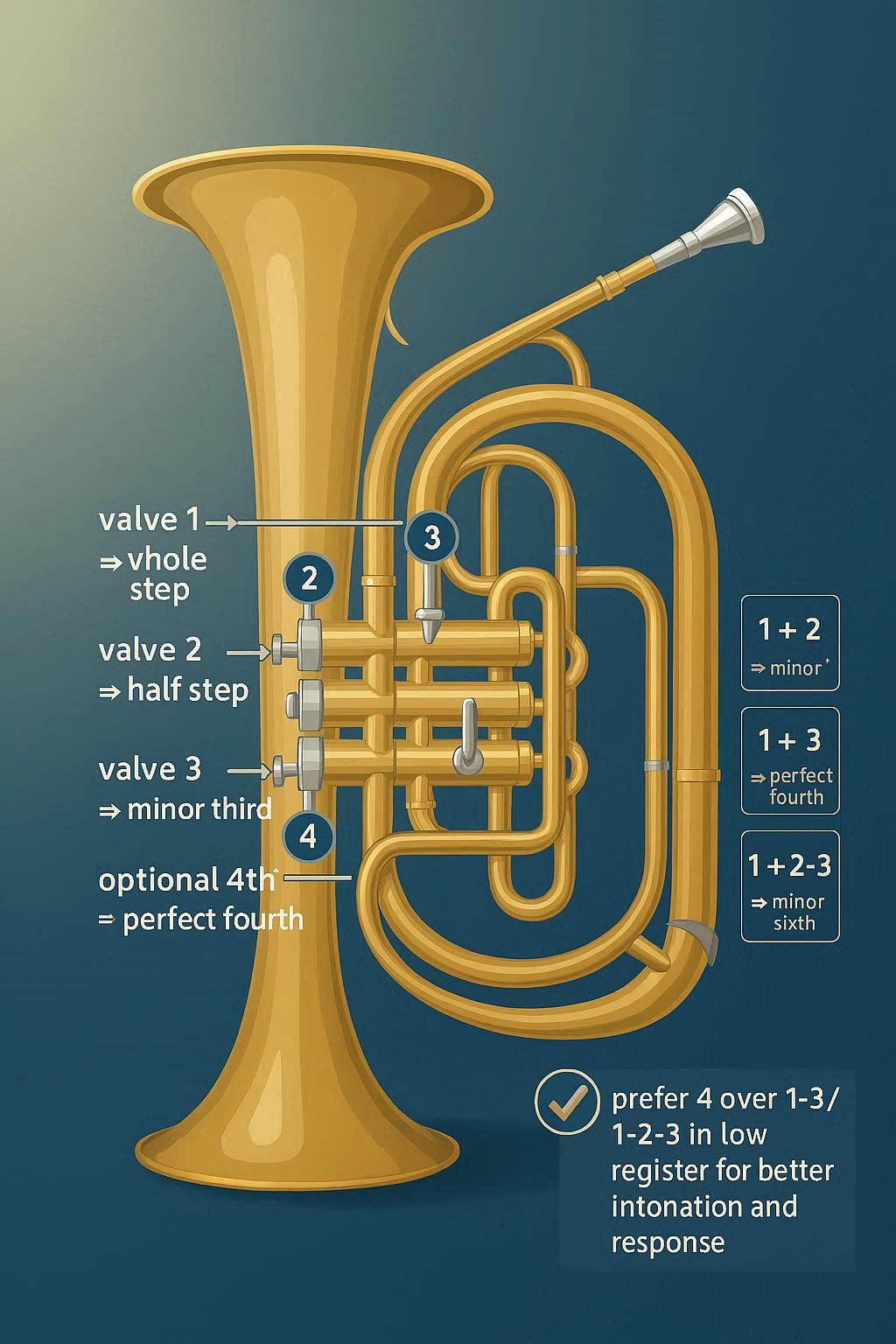
Valve down → longer tube → lower pitch
Range and Registers (BB♭)
- Low: Bb1–Bb2 — rich support; ensure steady air and relaxed jaw
- Middle: Bb2–G3 — core register for clarity and ensemble blend
- Upper: A3–Bb4+ — focused air; avoid spreading; articulate cleanly
Common Fingering Combinations
| Note | Fingering | Valve Combination | Field Notes |
|---|---|---|---|
| Bb (Bb2) | 0 | Open | Tune center while moving; anchor breath |
| C (C3) | 1‑3 | First+Third | Stabilize during direction changes |
| D (D3) | 1‑2 | First+Second | Alternate 3 if tendencies arise |
| Eb (Eb3) | 1 | First | Keep horn level; avoid bell dip |
| F (F3) | 0 | Open | Project through the box; avoid overblow |
| G (G3) | 1‑2 | First+Second | Clean articulation while stepping |
| Bb (Bb3) | 0 | Open | Unify style in upper register hits |
Harmonic Series
Open (0) yields Bb2, F3, Bb3, D4, F4… Combine valves to select different series. Practice lip slurs at tempo markings used on the field for endurance.
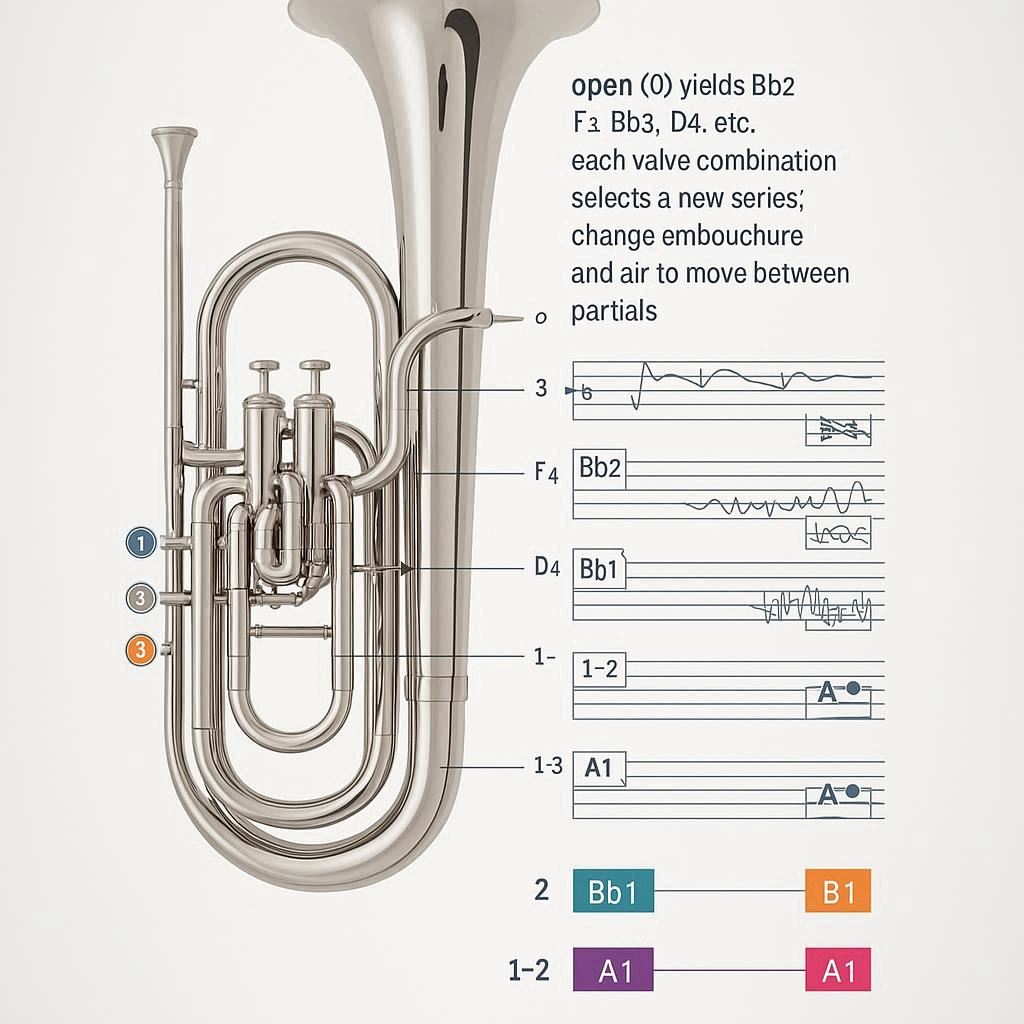
Field Posture and Carry
- Horn level with the box; bell angle consistent across forms.
- Neutral spine; bring horn to you—don’t collapse the torso.
- Right hand relaxed over valves; left hand stabilizes without squeezing.
- Step through the heel‑toe roll to avoid shaking the tone.
- Breathe in time; exhale through the phrase ends for stamina.
Learning Plan for Marching Season
- Daily long tones (Bb2–F3), then lip slurs on 0/1/2/1‑2/2‑3/1‑3 patterns.
- Scales in Bb, F, Eb, C with metronome + drone for intonation training.
- Articulation ladders (ta/da/ka) synchronized with step size and tempo.
- Projection reps: forte centers without spreading; pianissimo control on the move.
- Ensemble reps: align style, releases, and bell angle with the section.
Recommended Marching Baritone Models
Solid choices include Yamaha YBH series, Jupiter Quantum line, and King marching baritones. Evaluate valve action, balance at carry position, bell flare projection, and durability of bracing for drill demands.
Practice Tips and Common Field Issues
- Intonation drift: Use reference drones during drill runs; re‑center after moves.
- Tone shake while stepping: Stabilize core; reduce horn bounce; lighter articulation.
- Overblowing impacts: Focused air; match section resonance instead of sheer volume.
- Valve noise: Oil regularly; practice quiet, unified finger motion.
- Fatigue: Phrase breathing plans; maintain posture to keep air path open.