Guitar Fingering Chart

Interactive first‑position mapping • treble‑clef reading • technique & PDF

Interactive Guitar Fingering Chart

🛠️ How to Use This Chart

Step 1: Set Key Signature

Sharps and flats influence open‑string usage and finger spacing patterns.

Step 2: Select a Written Note

See suggested string and fret (0=open; 1–3 typical in first position) with treble‑clef display.

Step 3: Choose Efficient Options

Pick the option that fits position, timbre, and shift plan; check intonation with a tuner.

Current Key: C Major
No sharps or flats
Interactive Guitar Fretboard (First Position) Fretboard with E–A–D–G–B–E strings and markers for frets 0–3. E4 B3 G3 D3 A2 E2
Current Note: Select a note
Click a note button to see string and fret
Musical Notation (Treble Clef)
Select a note to display

Select a Note (First Position)

Guitar Fingering Chart Image
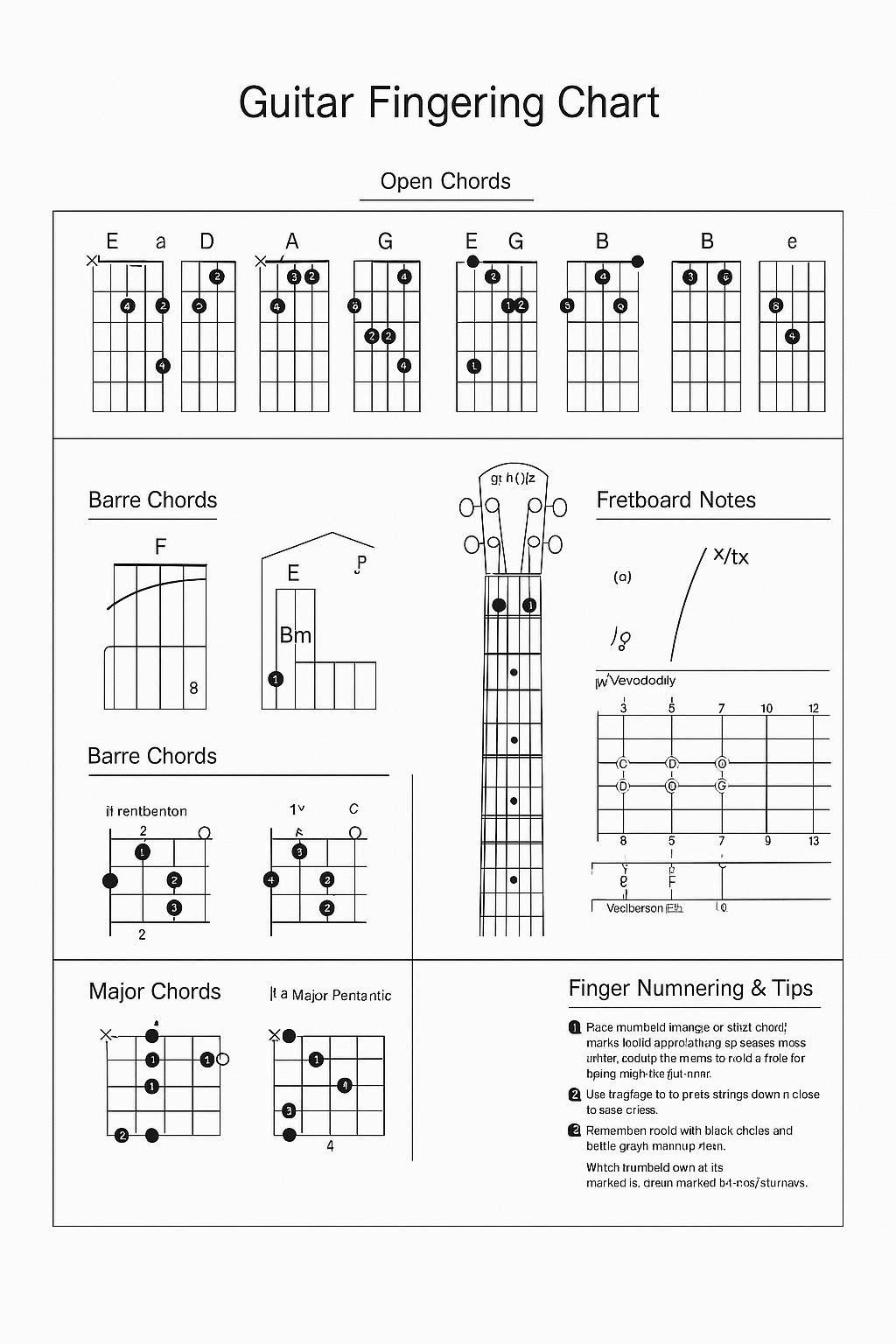
Guitar Fingering Chart Image

High‑contrast PDF for lessons and practice. Go to Download Page or open PDF directly: Open PDF

Understanding the Guitar

🔗 Related Instrument

The guitar is a six-string fretted instrument. For the lower-pitched four-string version, check out our Bass Guitar Fingering Chart.

Standard Tuning and First Position

  • Open strings: E2, A2, D3, G3, B3, E4.
  • Fingers: 1=index, 2=middle, 3=ring, 4=pinky; 0=open.
  • First position: Frets 1–3/4; prefer open strings for resonance and easy shifts when musical.

Left‑Hand and Intonation

  • Thumb relaxed behind neck; fingers drop from above; avoid collapsing knuckles.
  • Place close to frets to minimize buzz; adjust pressure—more is not always better.
  • Use drones/tuners; compare octaves/unisons across strings for pitch checks.

Right‑Hand Basics

  • Classical (i‑m‑a) alternation for rest/free strokes; pick players keep even attack and angle.
  • Keep tone consistent across strings; control noise on string changes.
  • Apoyando vs tirando: choose per phrasing/volume; pick angle for clarity vs warmth.

Guitar Common First‑Position Fingerings

Written Note String Fret Tip
G3 G 0 Anchor pitch; compare with D3 string 5th
A3 G 2 Alt: string 5 (open A2 octave)
B3 B 0 Watch string noise when crossing
C4 B 1 Keep close to fret; light pressure

Shifting Basics

  • Plan shifts between position anchors; keep thumb traveling with hand.
  • Guide finger slides lightly; minimize noise; land with shape ready.

Recommended Beginner Guitars

Choose appropriate scale length and string type (nylon vs steel) per style. Ensure comfortable action, stable tuners, and good intonation. Popular student lines include Yamaha, Cordoba (nylon), and Yamaha/Fender (steel).

Practice Tips and Common Issues

  • Left‑hand tension: Gentle thumb; curved fingers; avoid squeezing the neck.
  • Right‑hand consistency: Even tone on string changes; controlled attack.
  • Rhythm and articulation: Metronome; align finger lifts with stroke changes.
  • Intonation: Drones and octave checks; place near frets.
  • Daily structure: Open‑string tone → scales/patterns → etude → piece → cool‑down.

🎶 Reading Music

Guitar is written in treble clef but sounds one octave lower. If you’re new to key signatures, sharps/flats, or ledger lines, review our Music Notes Guide.

Technique Deep‑Dive for Guitar Efficient Fingering

Five CAGED Shapes at a Glance (First Position)

  • C shape: Suits keys with ♭B (F, C contexts); anchors around string‑2 fret‑1.
  • A shape: Works for A/D contexts; low‑string resonance with compact left‑hand.
  • G shape: Wide but resonant; use selectively for timbre and open‑string voicings.
  • E shape: Core shape for E/G contexts; efficient for scalar runs near nut。
  • D shape: Upper strings clarity; melodic figures with minimal crossing。

CAGED Overview (First Position Context)

  • CAGED shapes: Visualize C–A–G–E–D chord forms spanning frets 0–3/4 to map notes quickly.
  • Scale patterns: In C/G/D/A/E major, align finger patterns with open‑string resonances for stability.
  • Position choices: Prefer locations that minimize shifts while preserving desired timbre.

Choosing Positions and Timbre

  • Open vs fretted: Opens ring brighter and free shifts; fretted notes give uniform color.
  • String choice: Lower strings = warmer tone; higher strings = clearer attack.
  • Voice leading: Keep phrases on neighboring strings to reduce crossing noise.

Muting and Noise Control

  • Left‑hand release muting for rests; right‑hand palm/edge mute for low strings as needed.
  • Minimize squeaks by lifting/placing perpendicular and close to frets; adjust pick angle.

Shifting Practice

  • Plan exits/entries on longer values; guide finger glides lightly; land with the hand frame ready.
  • Slow practice with a drone and metronome; increase tempo gradually while preserving tone.

Capo and Alternate Tunings

  • Capo: Treat as a movable nut; remap first‑position shapes to new keys quickly.
  • Alternate tunings: This chart assumes standard EADGBE; for DADGAD/drop D, adjust string pitch references accordingly.