
Tuba Fingering Chart
Interactive fingering overview • bass-clef reading • downloadable PDF
Interactive Tuba Fingering Chart
🛠️ How to Use This Chart
Step 1: Choose Key Signature
Select a key to see which notes include sharps or flats for your music.
Step 2: Click a Written Note
Match the written bass‑clef note to its valve combination (0 = open; 1–4 = valves).
Step 3: Check Intonation
Use a tuner. The 4th valve often improves low‑range intonation and replaces 1‑3/1‑2‑3 combos.
Select a Note (Typical BB♭ Tuba)
Tuba Fingering Chart Image (PRINTABLE)
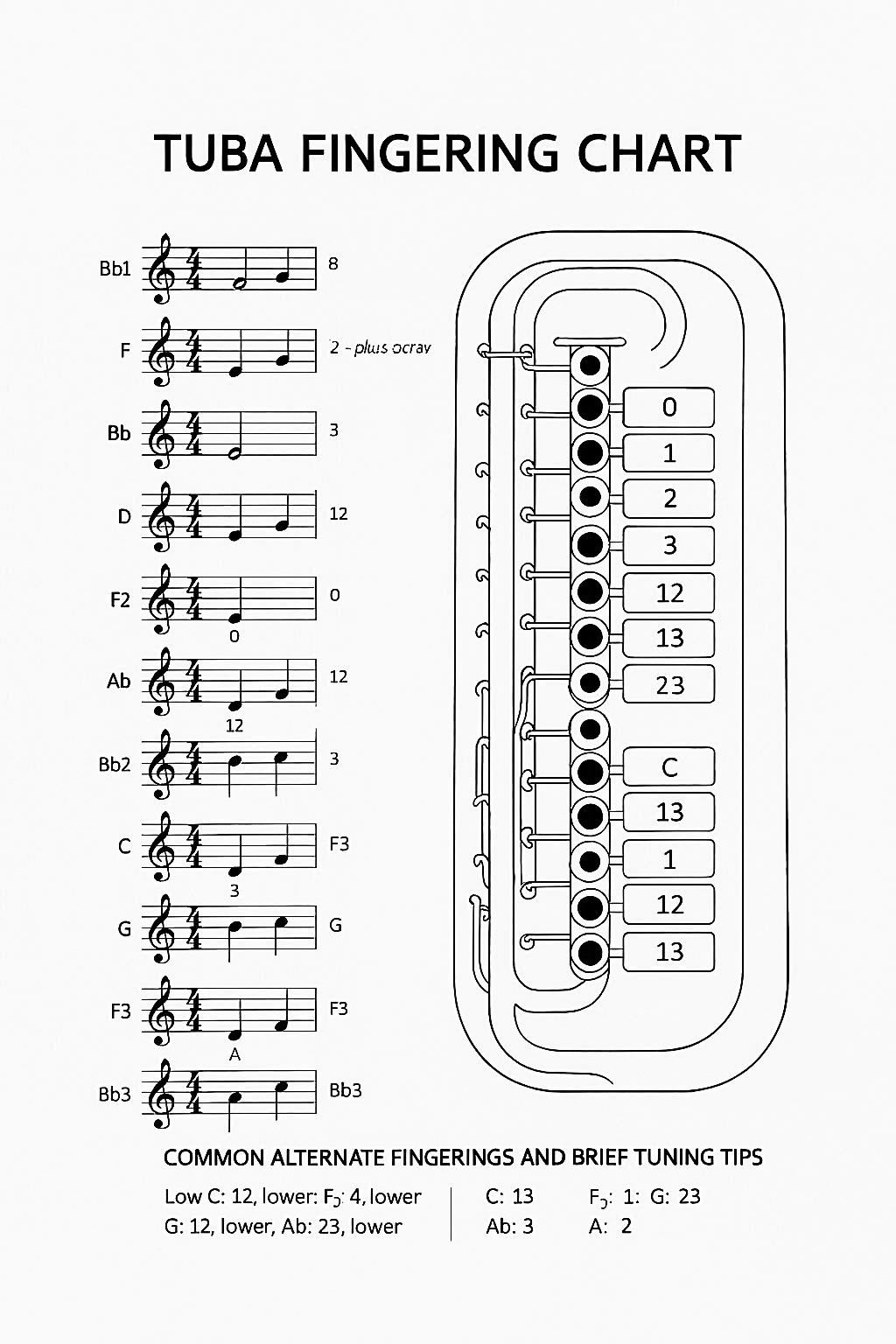
3 Valve Tuba Fingering Chart

High‑quality color PDF perfect for printing and carrying with you. Go to Download Page or open PDF directly: Open PDF
📚 Complete Tuba Fingering Guide
For a deep‑dive into valve combinations, 4th‑valve usage, and intonation strategies, see the full guide.
BEGINNER TUBA FINGERING CHART
(BB♭ Tuba | 4 Valves)
1. Basic Valve Combinations
| Note (Written) | Fingering | Valve Combination | Description |
|---|---|---|---|
| Bb2 | 0 | Open | Home pitch, easiest to produce |
| C3 | 4 | Fourth valve | Preferred over 1+3 for better intonation |
| D3 | 1+2 | First and second valves | Alternative: 3 if sharp |
| Eb3 | 1 | First valve only | Check slide if flat |
| F3 | 0 | Open | Stable mid-range note |
| G3 | 1+2 | First and second valves | Center pitch with steady air |
| A3 | 1 | First valve only | Major sixth from Bb |
| Bb3 | 0 | Open | One octave above Bb2 |
Tip: The same fingering can produce different notes by changing embouchure and air speed. Use the 4th valve for low notes to improve intonation!
2. Essential Beginner Scales
Practice these scales to build valve coordination, embouchure control, and breath support.
Bb Major Scale
Bb2 (0) - C3 (4) - D3 (1+2) - Eb3 (1) - F3 (0) - G3 (1+2) - A3 (1) - Bb3 (0)
F Major Scale
F2 (0) - G2 (1+2) - A2 (1) - Bb2 (0) - C3 (4) - D3 (1+2) - E3 (2) - F3 (0)
Eb Major Scale
Eb2 (1) - F2 (0) - G2 (1+2) - Ab2 (1+3) - Bb2 (0) - C3 (4) - D3 (1+2) - Eb3 (1)
3. Simple Practice Melodies
(Great for applying new valve combinations!)
"Hot Cross Buns":
Bb3 (0) - A3 (1) - G3 (1+2)
Bb3 (0) - A3 (1) - G3 (1+2)
G3 (1+2) - G3 (1+2) - G3 (1+2) - G3 (1+2)
A3 (1) - A3 (1) - A3 (1) - A3 (1)
Bb3 (0) - A3 (1) - G3 (1+2)
"Mary Had a Little Lamb":
E3 (2) - D3 (1+2) - C3 (4) - D3 (1+2) - E3 (2) - E3 (2) - E3 (2)
D3 (1+2) - D3 (1+2) - D3 (1+2)
E3 (2) - G3 (1+2) - G3 (1+2)
"Ode to Joy":
E3 (2) - E3 (2) - F3 (0) - G3 (1+2)
G3 (1+2) - F3 (0) - E3 (2) - D3 (1+2)
C3 (4) - C3 (4) - D3 (1+2) - E3 (2)
4. Tuba Fingering Tips for Beginners
- Use warm, low air from your diaphragm - low notes require more air volume.
- Maintain a relaxed embouchure (lip position) - avoid excessive mouthpiece pressure.
- Press valves quickly and completely, but without excessive force - keep fingers curved and close to valves.
- Practice finding each valve combination accurately - use a tuner to check intonation.
- Use the 4th valve for low C, B, and Bb - it provides better intonation than 1+3 or 1+2+3.
- Start with the middle register (Bb2-F3) - it's the most stable for beginners.
- Keep your posture tall and relaxed - bring the tuba to you, don't hunch over.
- Practice long tones on each valve combination to develop a steady sound.
- Use a mirror to check your posture, hand position, and embouchure.
- Don't grip the instrument too tightly - tension harms tone and endurance.
- Practice lip slurs (changing partials on the same fingering) to develop embouchure flexibility.
- Learn to read bass clef fluently - most tuba music is written in bass clef.
- Listen to professional tuba players for inspiration and sound concept.
- Clean and oil your valves regularly for smooth action.
- Be patient - mastering valve combinations, breath support, and embouchure takes time.
- Practice with a metronome to develop consistent timing.
- Work on clean articulation - use a light "tu/du" tongue placement.
- Balance air speed and embouchure to center the intended partial - avoid forcing high notes.
- Use valve slides to fine-tune intonation - pull slides slightly if notes are sharp.
Common Tuba Fingering Combinations (BB♭)
| Note | Fingering | Valve Combination | Use/Comment |
|---|---|---|---|
| BB♭ (Bb2) | 0 | Open | Home pitch; check with drone |
| C (C3) | 1‑3 or 4 | First+Third or Fourth | 4 gives better intonation |
| D (D3) | 1‑2 | First+Second | Alternative with 3 if sharp |
| Eb (Eb3) | 1 | First valve | Check slide if flat |
| F (F3) | 0 | Open | Stable mid‑range note |
| G (G3) | 1‑2 | First+Second | Center pitch with steady air |
| BB♭ (Bb3) | 0 | Open | One octave above Bb2 |
Tip: Use the 4th valve to replace 1‑3 (and 1‑2‑3) in the low register for improved resonance and intonation.