
Mellophone Fingering Chart
Interactive fingerings • F transposition • field posture & projection • PDF
Interactive Mellophone Fingering Chart
🛠️ How to Use This Chart (Field‑Ready)
Step 1: Set Key Signature
Choose the music key to visualize sharps/flats for your show.
Step 2: Select a Written Note
Click a note to see its valve combination and staff display (treble clef).
Step 3: Project and Tune
Use a tuner and drones. Keep bell level and air focused for forward projection.
Select a Note (Mellophone in F)
Mellophone Fingering Chart Image
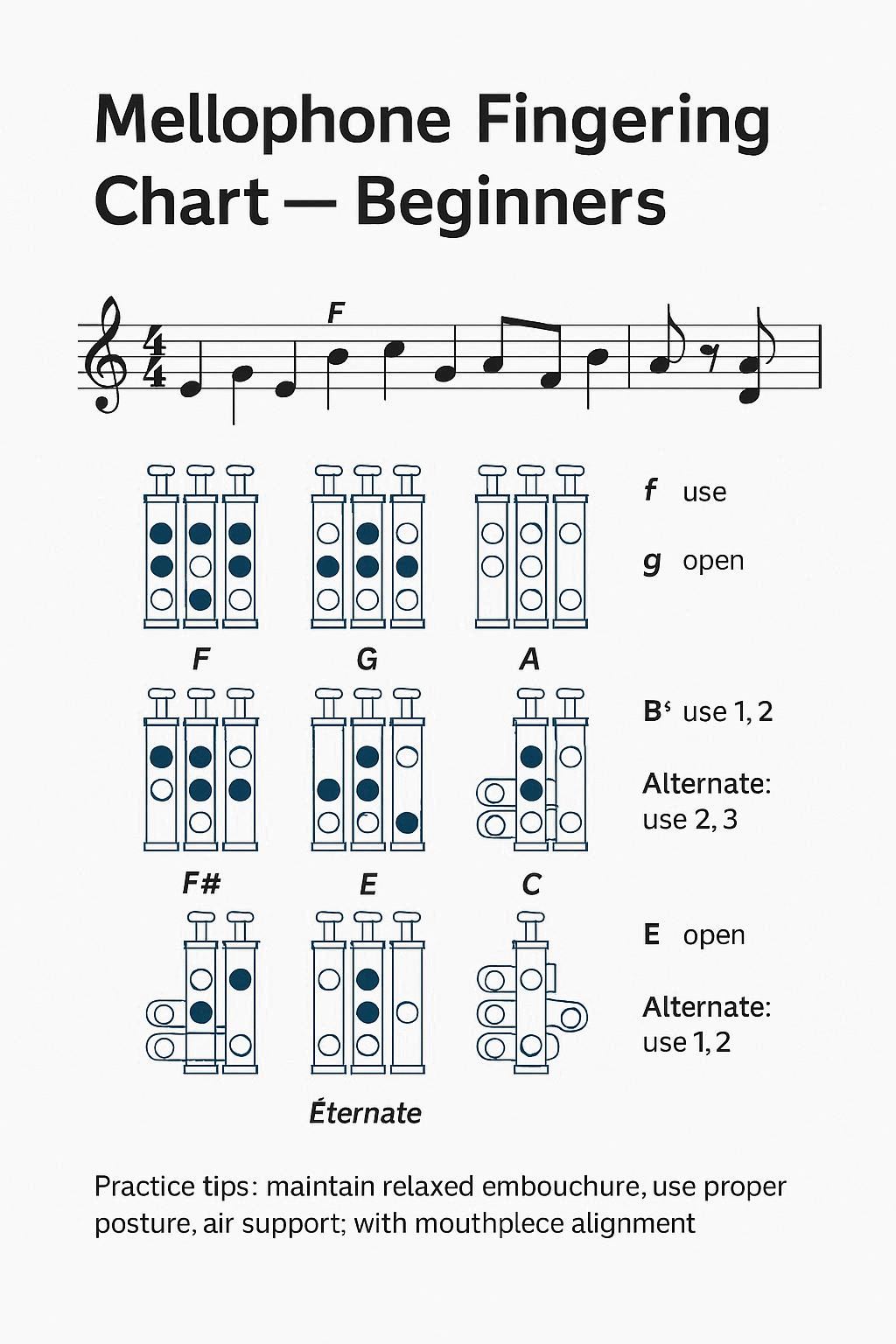
High‑contrast PDF for rehearsals and field reference. Go to Download Page or open PDF directly: Open PDF
🎶 Notation & Transposition
Mellophone reads treble clef and usually transposes in F (written C sounds concert F). This page shows written pitch for quick learning. For note reading basics, visit our Music Notes Guide.
Understanding the Mellophone
Mellophone Anatomy and Parts
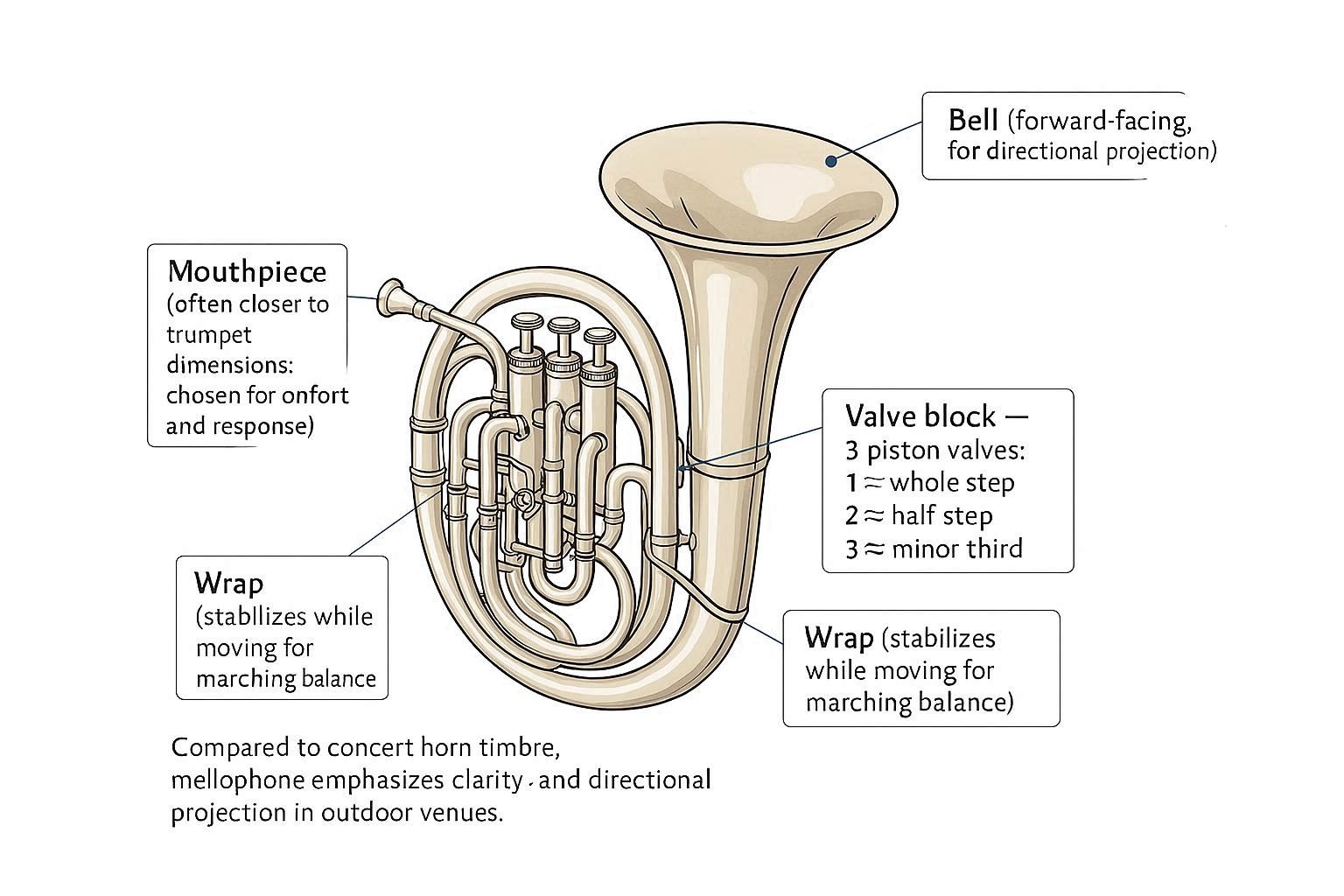
Designed for marching projection and balance, the mellophone features a forward‑facing bell, 3 piston valves, and a wrap that stabilizes while moving. Compared to concert horn timbre, mellophone emphasizes clarity and directional projection in outdoor venues.
- Mouthpiece: Often closer to trumpet dimensions than horn; choose for comfort and response.
- Valve Block: 1≈whole step, 2≈half step, 3≈minor third; combinations provide chromatic coverage.
- Slides: Keep clean, lubricated; small pulls help tuning in extreme temperatures.
- Bell: Forward flare for on‑field projection and clear attacks.
How Valves Change Pitch
Pressing valves lengthens tubing to lower pitch. Use efficient finger motion and steady air to stabilize intonation when stepping and changing directions on the field.
Range and Registers (Typical)
- Low: F3–B3 — warm air; avoid over‑relaxing the embouchure.
- Middle: C4–G4 — core register for ensemble clarity and blend.
- Upper: A4–D5+ — focused air; keep tone compact and avoid spread.
Common Fingering Combinations
| Written Note | Fingering | Valve Combination | Field Notes |
|---|---|---|---|
| C (C4) | 0 | Open | Home pitch; tune with drone |
| D (D4) | 1 | First | Secure slotting with steady air |
| E (E4) | 2 | Second | Half‑step clarity while stepping |
| F (F4) | 1+2 | First+Second | Alternate 3 for intonation if needed |
| G (G4) | 0 | Open | Project without spreading tone |
| A (A4) | 1+2 | First+Second | Keep articulation compact |
| B (B4) | 2 | Second | Tighten slot; avoid overblow |
Harmonic Series
Open (0) typically yields a series centered around written C/G relationships. Practice lip slurs and partial targeting at show tempos to build endurance and control.
Field Posture and Carry
- Horn level with the box; keep bell angle consistent across forms.
- Neutral spine; bring instrument to you—avoid collapsing the torso.
- Right hand relaxed over valves; left supports without squeezing.
- Heel‑toe roll minimizes tone shake during movement.
- Breath timing aligned with step size and phrase structure.
Learning Plan for Marching Season
- Daily long tones (C4–G4), then lip slurs on 0/1/2/1‑2/2‑3/1‑3 patterns.
- Scales in C, F, Bb, G with metronome + drone for intonation training.
- Articulation ladders (ta/da/ka) synchronized with step tempo.
- Projection reps: forte centers without spread; pp control while moving.
- Ensemble reps: align style, releases, and bell angle with section.
Recommended Mellophone Models
Look for reliable valve action, forward balance at carry position, stable pitch across registers, and durable bracing. Popular marching choices include Yamaha, King, and Jupiter mellophones; test with your program’s mouthpiece standards.
Practice Tips and Common Field Issues
- Intonation drift: Use drones during drill blocks; re‑center after moves.
- Tone shake while stepping: Stabilize core; minimize horn bounce; compact articulation.
- Overblowing: Focused air column; match resonance rather than volume.
- Valve noise: Oil regularly; practice quiet, unified finger motion.
- Fatigue: Phrase breathing plans; efficient posture to keep airway open.