
Bass Guitar Fingering Chart
Interactive first‑position mapping • bass‑clef reading • technique & PDF
Interactive Bass Guitar Fingering Chart
🛠️ How to Use This Chart
Step 1: Set Key Signature
Sharps and flats influence open‑string usage and finger spacing patterns.
Step 2: Select a Written Note
See suggested string and fret (0=open; 1–3 typical in first position) with bass‑clef display.
Step 3: Choose Efficient Options
Pick the option that fits position, timbre, and shift plan; check intonation with a tuner.
Select a Note (First Position)
Bass Guitar Fingering Chart Image (PRINTABLE)
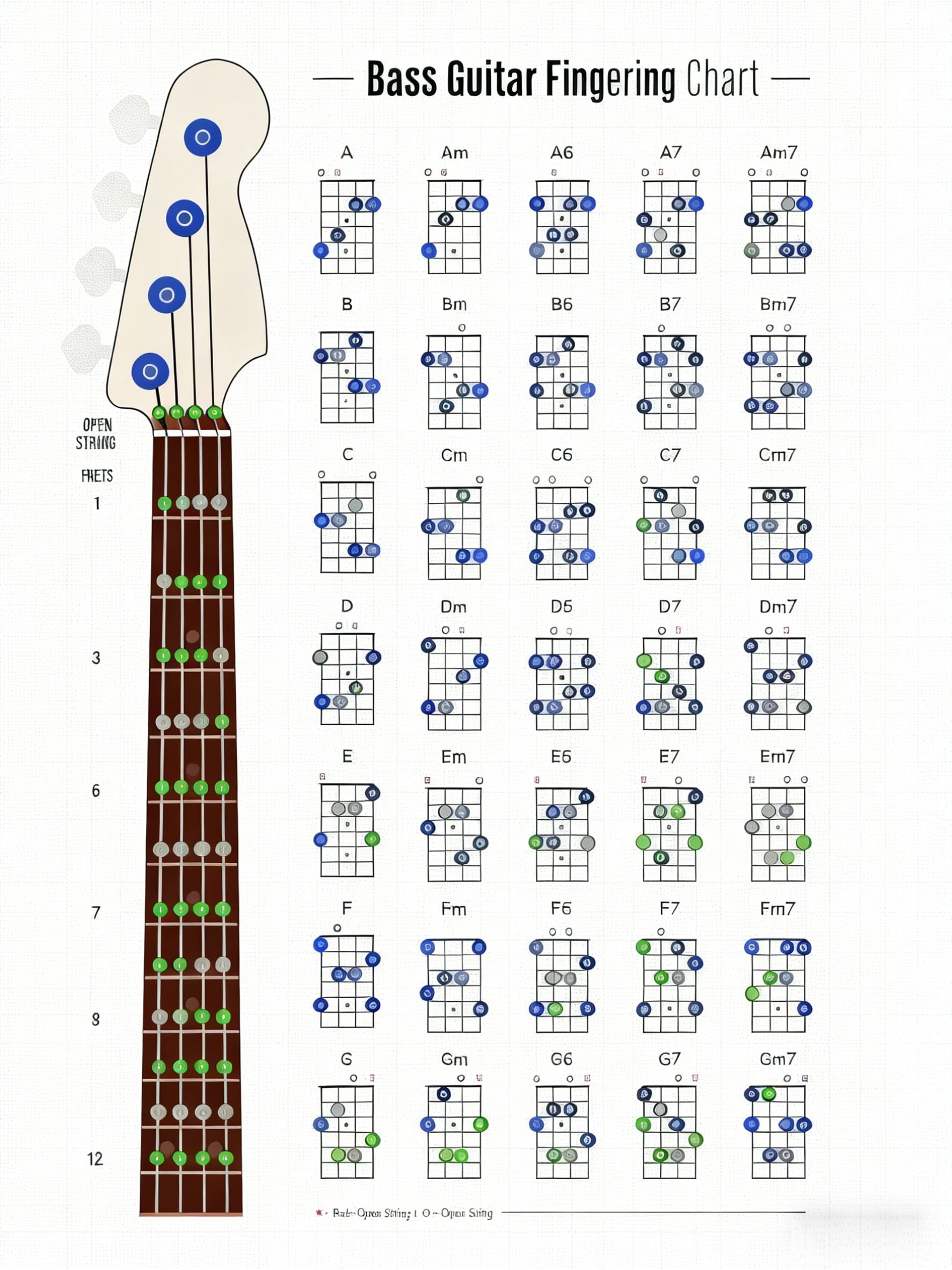
High‑contrast PDF for rehearsals and practice. Go to Download Page or open PDF directly: Open PDF
🎶 Reading Music
Bass guitar reads bass clef 𝄢. New to key signatures or accidentals? Review our Music Notes Guide.
BEGINNER BASS GUITAR FINGERING CHART
(4-String Bass | Standard Tuning: E-A-D-G)
1. Open Strings & Fretboard Basics
| String | Note (Open) | Fret 1 | Fret 2 | Fret 3 | Fret 4 | Fret 5 |
|---|---|---|---|---|---|---|
| G | G | G# | A | A# | B | C |
| D | D | D# | E | F | F# | G |
| A | A | A# | B | C | C# | D |
| E | E | F | F# | G | G# | A |
Tip: Use 1st finger = Fret 1, 2nd = Fret 2, 3rd = Fret 3, 4th = Fret 4 (one finger per fret).
2. Essential Beginner Chords (Root on A/E/D/G Strings)
(Red = Root Note; O = Open String)
A Major
G: O
D: O
A: 2 (B)
E: 3 (C#)
(Fingers: 2=middle, 3=ring)
A Minor
G: O
D: O
A: 2 (B)
E: 1 (C)
(Fingers: 1=index, 2=middle)
C Major
G: 2 (D)
D: 3 (E)
A: O
E: 1 (F)
(Fingers: 1=index, 2=middle, 3=ring)
G Major
G: 3 (B)
D: O
A: 2 (B)
E: O
(Fingers: 2=middle, 3=ring)
E Major
G: 1 (F#)
D: 2 (G#)
A: 2 (B)
E: O
(Fingers: 1=index, 2=middle)
3. Common Bass Riffs (1-2 Notes)
(Great for practice!)
"Seven Nation Army" (Intro):
A String: Fret 5 (D) → Fret 7 (E) → Fret 5 (D) → Fret 3 (C)
(Repeat)
"Smoke on the Water" (Bass Line):
D String: Fret 3 (F) → Fret 5 (G) → Fret 6 (G#) → Fret 5 (G)
(Repeat)
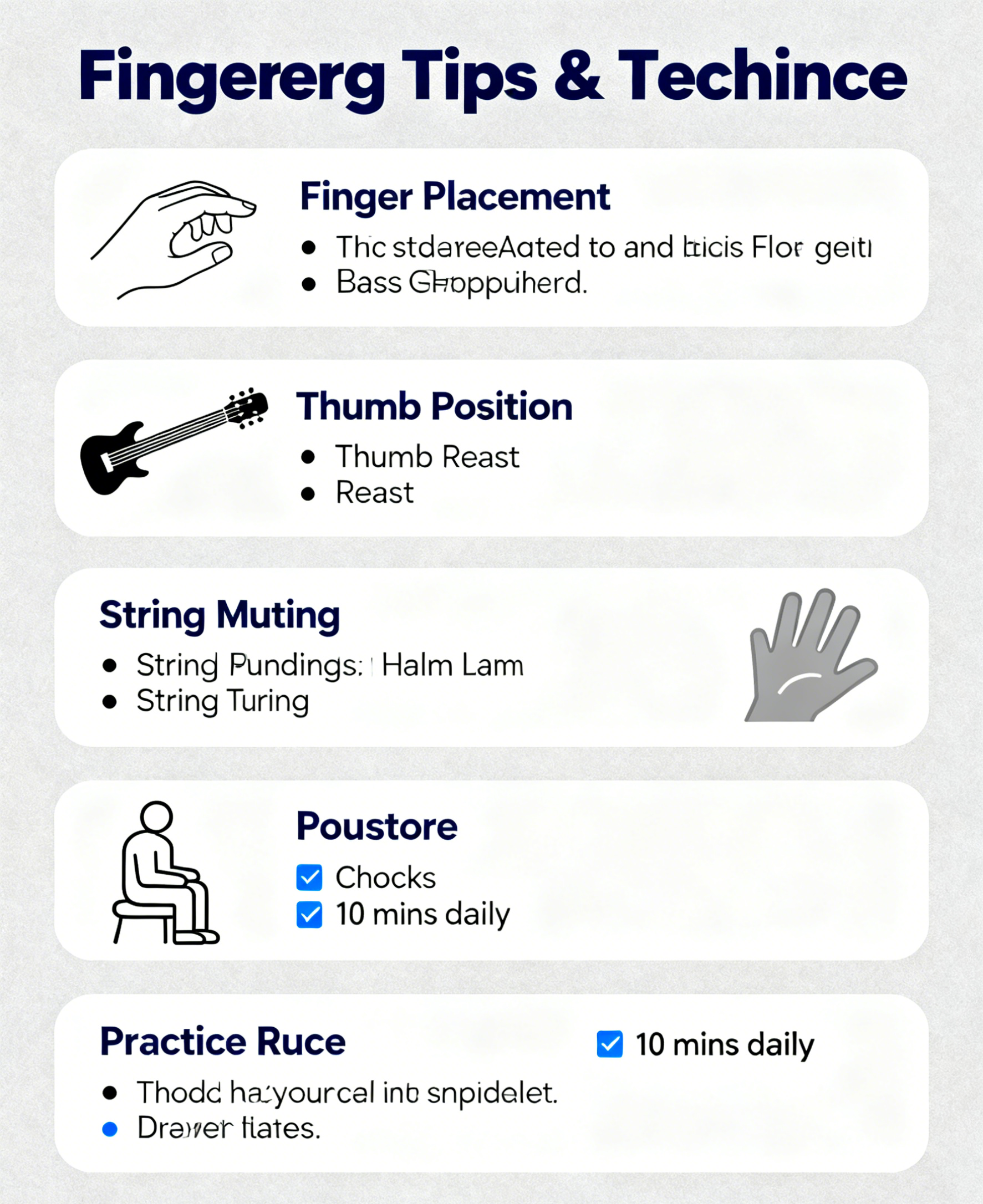
4. Fingering Tips for Beginners
- Keep fingers curved (don’t flatten them on strings).
- Press strings close to the fret wire (not on the metal).
- Mute unused strings with your palm (to avoid buzz).
- Start slow—focus on clean notes before speed!
Understanding the Bass Guitar
🔗 Related Instrument
The bass guitar is the lower-pitched four-string version of the guitar. If you're learning bass guitar, you may also find our Guitar Fingering Chart helpful, as many bass players start on guitar to develop fretting technique and music theory knowledge.
Standard Tuning and First Position
- Open strings: E1, A1, D2, G2.
- Fingers: 1=index, 2=middle, 3=ring, 4=pinky; 0=open.
- First position: Frets 1–3/4; prefer open strings for resonance and easy shifts when musical.
Left‑Hand and Intonation
- Thumb relaxed; fingers curved; place close to frets to minimize buzz.
- Use drones/tuners; compare fifths/octaves across strings for pitch checks.
- Economy of motion: prepare next position early; avoid gripping.
Right‑Hand Basics
- Alternate index/middle (i‑m) for even tone;
- Mute unused strings with both hands to keep groove clean.
- Adjust contact point for timbre: nearer bridge = brighter, nearer neck = warmer。
Bass Guitar Common First‑Position Fingerings
| Written Note | String | Fret | Tip |
|---|---|---|---|
| G1 | E1 | 3 | Match with open G2 octave |
| A1 | A1 | 0 | Anchor pitch; groove reference |
| B1 | A1 | 2 | Economy of motion |
| C2 | A1 | 3 | Choose for consistent color |
Shifting Basics
- Plan shifts within rests or sustained notes; guide finger lightly; land with shape ready.
- Slow practice with a drone and metronome; increase tempo while maintaining tone.
Recommended Beginner Basses
Ensure comfortable action, stable tuners, solid intonation, and appropriate scale length. Popular student lines include Squier by Fender, Yamaha, and Ibanez.
Practice Tips and Common Issues
- Left‑hand tension: Gentle thumb; curved fingers; avoid squeezing the neck.
- Right‑hand consistency: Even tone on string changes; controlled attack.
- Rhythm and articulation: Metronome; align finger lifts with stroke changes.
- Intonation: Drones and octave checks; place near frets.
- Daily structure: Open‑string tone → scales/patterns → groove/etude → piece → cool‑down.