French Horn Fingering Chart
Clear fingering overview + horn‑specific fundamentals + practice roadmap
Interactive French Horn Fingering Chart
🟡 How to Use This Interactive Chart (French Horn)
Step 1: Choose Key Signature and Side
Select a key signature, then choose the B♭ or F side. The B♭ side responds more easily in the middle register; the F side offers a warmer tone and greater stability in the low register.
Step 2: Click a Note
Click a note below to display the corresponding valve combination. The horn diagram will highlight the required valves and the thumb trigger.
Step 3: Match the Partial
The same fingering maps to multiple partials. Use steady air and consistent articulation to center the intended pitch—avoid forcing the upper harmonics.
Select a Note
French Horn Overview
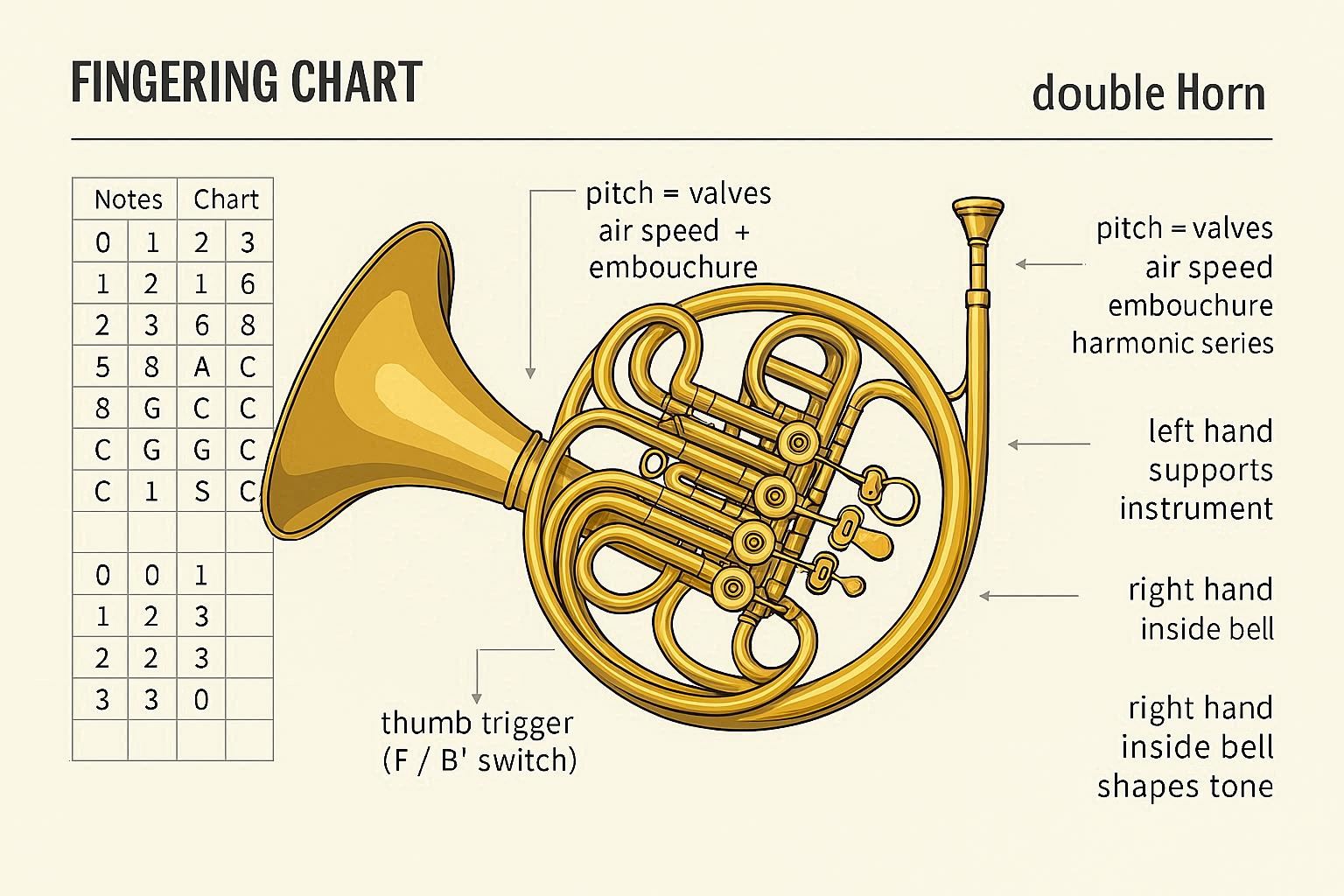
The modern double horn switches between two tubing lengths (F and B♭) using a thumb trigger plus three rotary valves operated by the right hand. Pitch changes come from a combination of valve choices, air speed, embouchure, and the harmonic series. The left hand supports the instrument while the right hand shapes the tone inside the bell.
How to Use This Chart
- Start on the B♭ side (thumb trigger engaged) for easier response in the mid‑range.
- Match each valve combination to its harmonic levels slowly; do not force high partials.
- Use a tuner and drone to center pitch while you memorize patterns.
French Horn Fingering Chart (At‑a‑Glance,PRINTABLE)
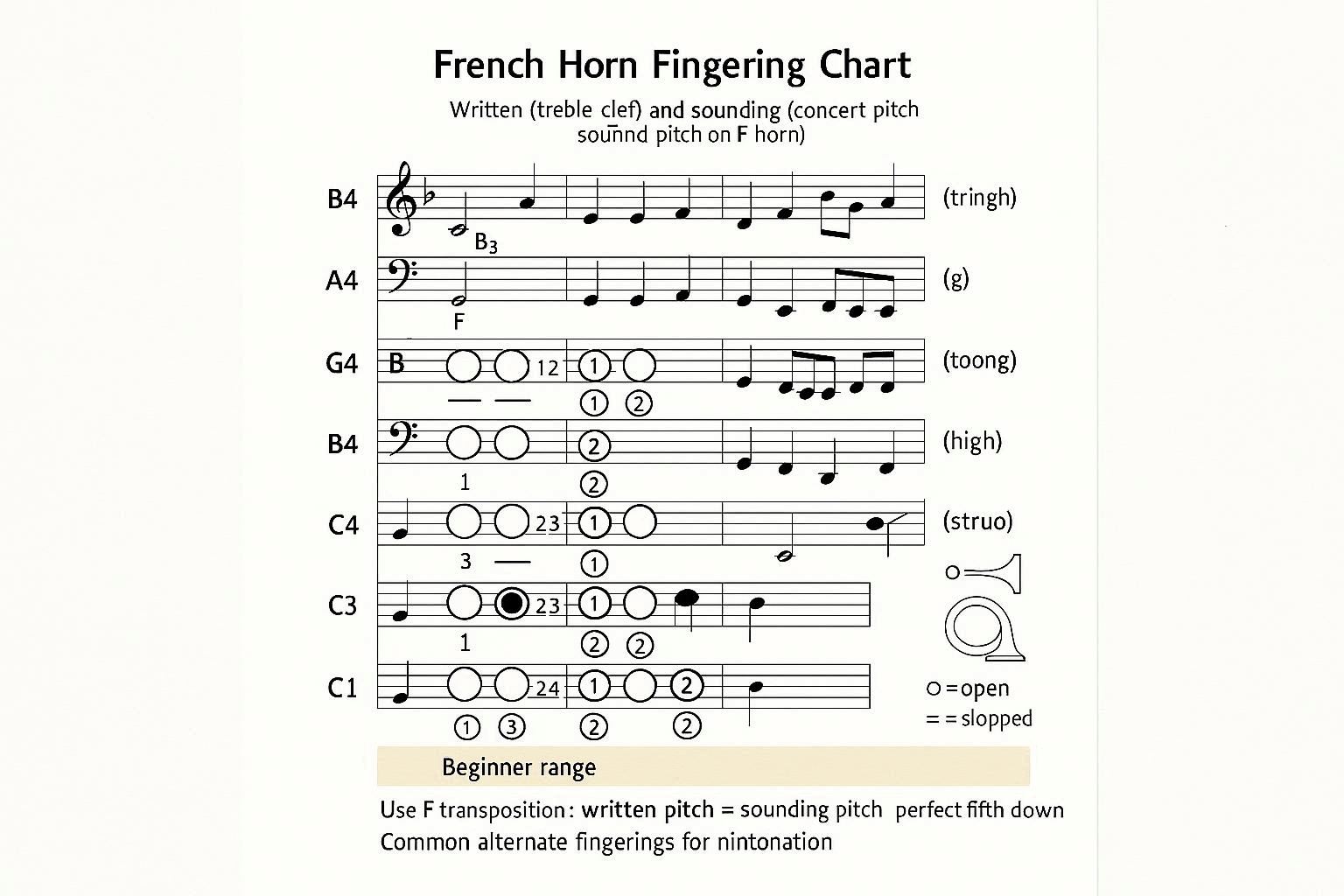
Schematic overview of B♭/F sides, valve combinations, and common harmonic levels
Need a printable reference? Download our French Horn Fingering Chart PDF for offline practice and reference.
BEGINNER FRENCH HORN FINGERING CHART
(Double Horn | B♭/F Sides | 3 Valves + Thumb Trigger)
1. Basic Valve Combinations
| Note (Written) | Side | Valve Combination | Description |
|---|---|---|---|
| C4 | B♭ | 0 (Open) | No valves, thumb engaged |
| C4 | F | 0 (Open) | No valves, thumb released |
| D4 | B♭ | 1+2 | First and second valves |
| E4 | B♭ | 2 | Second valve only |
| F4 | B♭ | 0 (Open) | No valves, thumb engaged |
| G4 | B♭ | 1 | First valve only |
| A4 | B♭ | 1+2 | First and second valves |
| B4 | B♭ | 2 | Second valve only |
| C5 | B♭ | 0 (Open) | No valves, thumb engaged (octave) |
Tip: The same fingering can produce different notes by changing embouchure and air speed. B♭ side is easier for beginners in the middle register!
2. Essential Beginner Scales
Practice these scales to build valve coordination, embouchure control, and side switching.
F Major Scale (B♭ Side)
F4 (0) - G4 (1) - A4 (1+2) - Bb4 (2) - C5 (0) - D5 (1+2) - E5 (2) - F5 (0)
Bb Major Scale (B♭ Side)
Bb3 (2) - C4 (0) - D4 (1+2) - Eb4 (1+3) - F4 (0) - G4 (1) - A4 (1+2) - Bb4 (2)
C Major Scale (B♭ Side)
C4 (0) - D4 (1+2) - E4 (2) - F4 (0) - G4 (1) - A4 (1+2) - B4 (2) - C5 (0)
3. Simple Practice Melodies
(Great for applying new valve combinations!)
"Hot Cross Buns":
B4 (2) - A4 (1+2) - G4 (1)
G4 (1) - G4 (1) - G4 (1) - G4 (1)
A4 (1+2) - A4 (1+2) - A4 (1+2) - A4 (1+2)
B4 (2) - A4 (1+2) - G4 (1)
"Mary Had a Little Lamb":
E4 (2) - D4 (1+2) - C4 (0) - D4 (1+2) - E4 (2) - E4 (2) - E4 (2)
D4 (1+2) - D4 (1+2) - D4 (1+2)
E4 (2) - G4 (1) - G4 (1)
"Ode to Joy":
E4 (2) - E4 (2) - F4 (0) - G4 (1)
G4 (1) - F4 (0) - E4 (2) - D4 (1+2)
C4 (0) - C4 (0) - D4 (1+2) - E4 (2)
4. French Horn Fingering Tips for Beginners
- Start with the B♭ side (thumb engaged) - it's easier to produce a clear sound in the middle register.
- Maintain a relaxed embouchure (lip position) for clear tone - avoid excessive mouthpiece pressure.
- Use consistent air support from your diaphragm - steady air is crucial for horn playing.
- Press valves quickly and completely, but without excessive force - keep fingers curved and close to valves.
- Practice finding each valve combination accurately - use a tuner to check intonation.
- Learn to coordinate thumb trigger with valve combinations for smooth side switching.
- Keep your right hand relaxed in the bell - it shapes tone and helps with intonation.
- Practice long tones on each valve combination to develop a steady sound.
- Use a mirror to check your posture, hand position, and embouchure.
- Don't grip the instrument too tightly - tension harms tone and endurance.
- Practice lip slurs (changing partials on the same fingering) to develop embouchure flexibility.
- Learn when to use F side vs B♭ side - F side offers warmth in low register, B♭ side is brighter in mid/high.
- Listen to professional French horn players for inspiration and sound concept.
- Clean and oil your valves regularly for smooth action.
- Be patient - mastering valve combinations, side switching, and embouchure takes time.
- Practice with a metronome to develop consistent timing.
- Work on clean articulation - use a light "tu/du" tongue placement.
- Balance air speed and embouchure to center the intended partial - avoid forcing high notes.
Understanding French Horn Mechanics
Valves and Thumb Trigger
- Valve 1: Lowers pitch by a whole step.
- Valve 2: Lowers pitch by a half step.
- Valve 3: Lowers pitch by 1½ steps.
- Thumb (B♭/F): Switches tubing length; B♭ side is shorter (brighter, easier response), F side is longer (warmer, different intonation tendencies).
Harmonic Series and Partials
Like all brass, the horn’s valve sets select a fundamental series. Your embouchure and air speed choose which partial sounds. The same fingering can produce multiple notes across the series—accuracy comes from centered air, stable aperture, and consistent tongue placement.
Right Hand in the Bell
- Neutral hand shapes timbre and stabilizes pitch.
- Further insertion darkens tone and slightly raises pitch; fully stopped raises pitch roughly a semitone (use dedicated stopped fingerings).
Transposition and Notation (Horn in F / B♭)
- Horn in F (most common): Written C sounds a concert F (down a perfect fifth).
- Horn in B♭: Written C sounds a concert B♭ (down a major second).
- Reading: Ensemble parts are usually treble clef. This page’s interactive examples display in treble clef at written pitch for clarity; remember the transposition when matching to concert pitch resources.
- Side choice: B♭ side often centers better in mid/high passages; F side offers warmth and security in low register and for stopped notes.
Alternate and Stopped Fingerings (Selected)
| Written Note | Side | Standard | Alternate | Use Case |
|---|---|---|---|---|
| C4 | B♭ | 0 | F‑side 0 | Color/tuning choice in soft passages |
| D4 | B♭ | 1+2 | 3 | Stabilize pitch; smoother slur context |
| E4 | B♭ | 2 | F‑side 1 | Match timbre; improve slotting |
| Stopped (any) | F | Hand fully closed in bell | Use dedicated “+” fingerings (typically −1 semitone) | Authentic stopped timbre and tuning |
Range and Registers
Work across registers gradually to keep embouchure relaxed and pitch centered.
| Register | Typical Notes | Focus | Common Issues |
|---|---|---|---|
| Low | F2–C3 | Support, open oral cavity, steady air | Flat pitch, delayed response |
| Middle | C4–G4 | Even tone across partials, clean attacks | Partial cracks, inconsistent articulation |
| High | A4–C6 | Small aperture, air focus, rest between reps | Sharp pitch, fatigue |
How to Hold the French Horn
Keep shoulders relaxed and spine neutral. Left hand supports the instrument at the valve cluster; right hand is gently cupped inside the bell with the wrist straight. Avoid gripping tightly—tension harms tone and endurance.
Step‑by‑Step Learning Plan
Weeks 1–2
- Long tones on B♭‑side mid‑partials; establish centered tone and clean note starts.
- Simple slur patterns across adjacent partials; add light single tonguing.
Weeks 3–4
- Introduce F‑side alternates for intonation; memorize 0/1/2/1‑2/2‑3 patterns.
- Slow scales in F and B♭; use tuner/drone pairing for stability.
Practice Tips and Common Issues
- Air first, fingers second: Prioritize a steady, resonant airstream. Use soft, even valve motion to avoid bumps in slurs.
- Center the intended partial: Start on comfortable mid‑partials (written C4–G4). If you crack upward, lighten air pressure and narrow the aperture; if you sag, firm the air and slightly raise tongue position.
- Valve efficiency: Keep fingers curved with minimal lift. Aim for quiet, simultaneous motion on combinations (1+2, 2+3, 1+3).
- Clean articulation: Favor a light “tu/du” at the tip of the tongue. For clarity in the upper register, shorten the tongue contact but keep the air continuous.
- Intonation strategy: Check frequently against a drone. Choose B♭ vs F side based on which centers pitch better in context, then fine‑tune with slides and embouchure.
- Switching sides musically: Plan side changes at slurs or breaths. Practice slow alternation patterns (B♭→F) on the same written pitch to memorize feel and intonation tendencies.
- Low register stability: On F side, use warm air and relaxed jaw. Avoid over‑pressing the mouthpiece; support with abdominal engagement.
- High register health: Small aperture, focused air, frequent rests. Keep dynamics honest—don’t chase volume at the expense of control.
- Hand position in bell: Neutral hand shapes timbre and pitch. More insertion darkens tone and sharpens pitch; fully stopped notes require specific fingerings and careful pitch awareness.
- Daily structure: Long tones → lip slurs → scales/arpeggios → etudes/repertoire. Track tempo and range to ensure gradual, safe progress.
- Common pitfalls: Excess pressure, overblowing, late valve timing, and unplanned side choices. Address one variable at a time when troubleshooting.
French Horn Models for Beginner
When possible, test instruments with a teacher or experienced player. Prioritize smooth valve action, consistent intonation across sides, comfortable ergonomics, and a serviceable build from reputable makers.
- Single vs Double: Singles (often F) are lighter and simpler; doubles (B♭/F) offer versatility, better intonation options, and are standard beyond the earliest stages.
- Bell style: Fixed bells are more stable; detachable bells aid transport and fit in smaller cases, with minimal tonal trade‑off on quality builds.
- Mouthpiece choice: Start with a medium cup and rim (e.g., Yamaha 32C4, Holton Farkas Medium Deep) and adjust with a teacher based on response and endurance.
| Model | Type | Typical Price | Notes |
|---|---|---|---|
| Yamaha YHR‑322/314 | Single (F) | Entry‑level | Lightweight, easy response for first‑year students. |
| Conn 6D/8D (used) | Double (B♭/F) | Mid (used market) | Classic American sound; check valve compression on older horns. |
| Holton H379 | Double (B♭/F) | Mid | Reliable student/intermediate option with solid intonation. |
| Jupiter JHR1100 | Double (B♭/F) | Mid | Good value; ergonomic wraps suit smaller hands. |
| Eastman EFH‑682/685 | Double (B♭/F) | Mid | Consistent build quality; responsive valves and stable pitch. |
- Maintenance matters: Smooth rotary action and airtight slides dramatically affect playability—budget for professional setup on used horns.
- Resale and longevity: Reputable brands hold value and can carry a student into advanced repertoire with a mouthpiece upgrade.