Trombone Fingering Chart
Interactive slide position demonstration + beginner learning guide + free PDF download
Interactive Trombone Slide Position Chart
🎺 How to Use This Interactive Chart
Step 1: Choose Key Signature
Select your desired key signature from the dropdown menu. This will show you which notes are sharp or flat in that key.
Step 2: Click on a Note
Click any note button below to see the correct slide position. The trombone diagram will highlight the slide position you need to use.
Step 3: Learn the Position
Study the highlighted slide position on the trombone and read the position description. Practice until it becomes automatic!
Select a Note
Trombone Slide Position Chart Image (PRINTABLE)
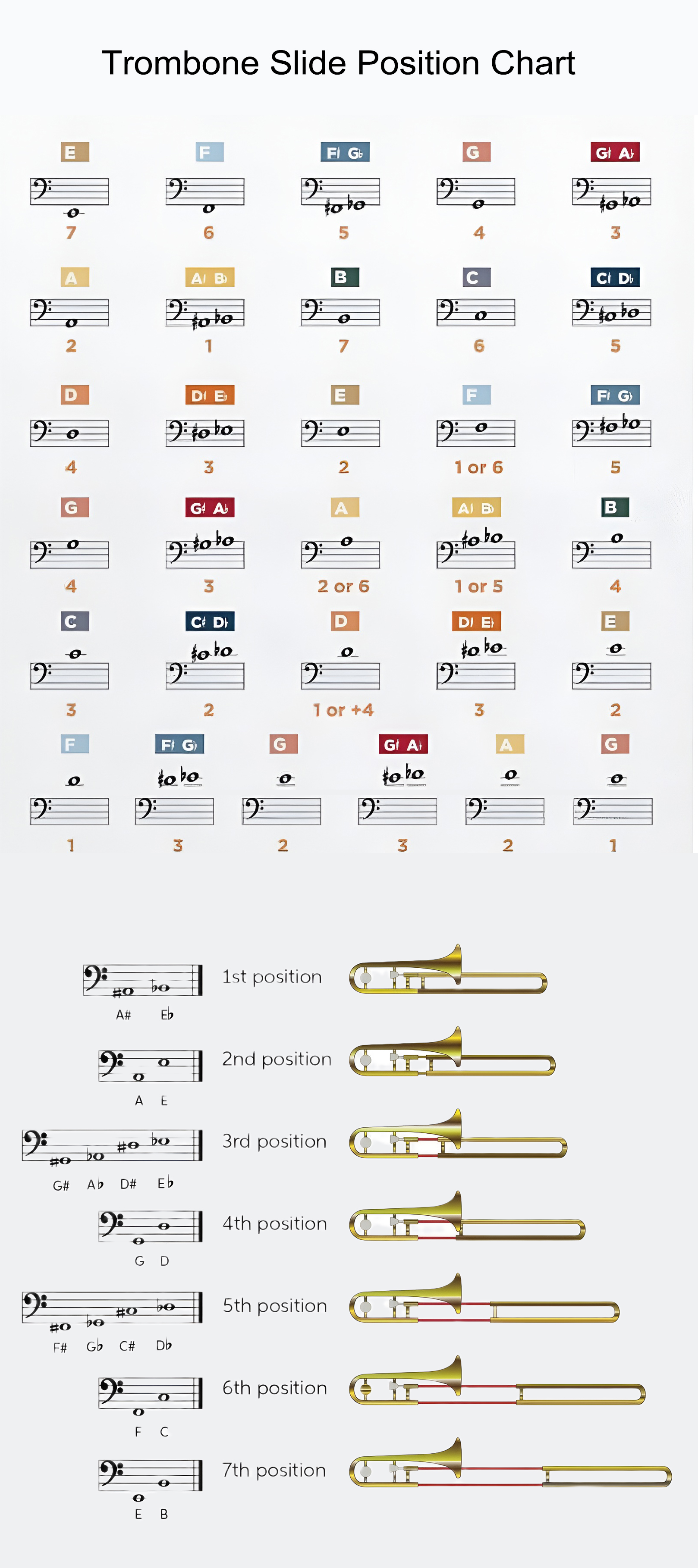
High-quality color PDF perfect for printing and carrying with you. Go to Download Page or open PDF directly: Open PDF
BEGINNER TROMBONE FINGERING CHART
(Tenor Trombone | 7 Slide Positions)
1. Basic Slide Position Combinations
| Note | Slide Position | Position Description | Description |
|---|---|---|---|
| Bb2 | 1 | Slide closest to player | Fundamental note, easiest to produce |
| A2 | 2 | Slide slightly extended | One whole step down from Bb |
| Ab2 | 3 | Slide moderately extended | Minor third from Bb |
| G2 | 4 | Slide halfway extended | Perfect fourth from Bb |
| Gb2 | 5 | Slide mostly extended | Tritone from Bb |
| F2 | 6 | Slide nearly fully extended | Perfect fifth from Bb |
| E2 | 7 | Slide fully extended | Major sixth from Bb |
| Bb3 | 1 | Slide closest to player | One octave above Bb2 |
Tip: The same slide position can produce different notes by changing embouchure (lip tension) and air speed. Position 1 is the easiest to start with!
2. Essential Beginner Scales
Practice these scales to build slide position accuracy and embouchure control.
Bb Major Scale
Bb2 (1) - C3 (6) - D3 (4) - Eb3 (3) - F3 (1) - G3 (4) - A3 (2) - Bb3 (1)
F Major Scale
F2 (6) - G2 (4) - A2 (2) - Bb2 (1) - C3 (6) - D3 (4) - E3 (2) - F3 (1)
C Major Scale
C3 (6) - D3 (4) - E3 (2) - F3 (1) - G3 (4) - A3 (2) - B3 (1) - C4 (6)
3. Simple Practice Melodies
(Great for applying new slide positions!)
"Hot Cross Buns":
Bb3 (1) - A3 (2) - G3 (4)
G3 (4) - G3 (4) - G3 (4) - G3 (4)
A3 (2) - A3 (2) - A3 (2) - A3 (2)
Bb3 (1) - A3 (2) - G3 (4)
"Mary Had a Little Lamb":
E3 (2) - D3 (4) - C3 (6) - D3 (4) - E3 (2) - E3 (2) - E3 (2)
D3 (4) - D3 (4) - D3 (4)
E3 (2) - G3 (4) - G3 (4)
"Ode to Joy":
E3 (2) - E3 (2) - F3 (1) - G3 (4)
G3 (4) - F3 (1) - E3 (2) - D3 (4)
C3 (6) - C3 (6) - D3 (4) - E3 (2)
4. Trombone Slide Position Tips for Beginners
- Keep the slide parallel to the ground - avoid sideways pressure or tilting.
- Use smooth, even slide movements - avoid "slamming" the slide into position.
- Maintain a relaxed embouchure (lip position) for clear tone.
- Use consistent air support from your diaphragm.
- Practice finding each position accurately - use a tuner to check intonation.
- Start with position 1 (Bb) as it's the easiest to produce a clear sound.
- Keep your right hand relaxed - thumb and index finger grip the slide brace.
- Practice long tones on each position to develop a steady sound.
- Use a mirror to check your posture and slide angle.
- Don't grip the slide too tightly - allow it to move freely.
- Practice glissandos (sliding between positions) to improve slide technique.
- Listen to professional trombone players for inspiration.
- Clean and lubricate your slide regularly for smooth movement.
- Be patient - mastering slide positions and embouchure takes time.
- Practice with a metronome to develop consistent timing.
Understanding Trombone Slide Positions
🔗 Related Instrument
The trombone is the standard slide brass instrument. For the larger, lower-pitched version with additional valves, check out our Bass Trombone Fingering Chart.
Trombone Anatomy and Parts
Before learning slide positions, it's essential to understand the trombone's main components and how they work together to produce sound.
Key Components:
- Mouthpiece: Where you buzz your lips to create sound
- Lead pipe: Connects mouthpiece to main slide
- Inner slide: Movable inner tubing
- Outer slide: Stationary outer tubing
- Bell: Amplifies and projects the sound
- Water key: Releases condensation from the instrument
- Tuning slide: Adjusts overall pitch of the instrument
How Slide Positions Change Trombone Pitch
The trombone uses a slide mechanism instead of valves. When you extend the slide, you increase the tube length, which lowers the pitch. Each position represents a specific tube length.
Slide Position Functions:
- Position 1: Slide closest to player (shortest tube)
- Position 2: Slide slightly extended
- Position 3: Slide moderately extended
- Position 4: Slide halfway extended
- Position 5: Slide mostly extended
- Position 6: Slide nearly fully extended
- Position 7: Slide fully extended (longest tube)
Understanding Musical Notes
Musical notes are organized in a specific pattern. Understanding this pattern is crucial for reading music and learning slide positions.
Want a deeper primer? Read our Music Notes Guide for beginners.
The Musical Alphabet:
Musical notes use the letters A, B, C, D, E, F, G, then repeat. In trombone music, middle C is written as C4.
- Natural Notes: C, D, E, F, G, A, B
- Sharp (♯): Raises a note by one half step (e.g., C♯)
- Flat (♭): Lowers a note by one half step (e.g., B♭)
Note: Trombone is a non-transposing instrument - when you play "C", it sounds as C on piano.
Half Steps and Whole Steps
Understanding the distance between notes is essential for learning scales and slide position patterns.
Half Step (Semitone):
The smallest distance between two notes. On a piano, it's from one key to the very next key (including black keys).
Examples:
- C to C♯ (or D♭)
- E to F
- B to C
Whole Step (Tone):
Equal to two half steps. Skip one key on the piano.
Examples:
- C to D (2 half steps)
- F to G (2 half steps)
- A to B (2 half steps)
Trombone Octaves and Pitch Ranges
An octave is the interval between one note and another with the same letter name but different pitch. The trombone typically covers about 3 octaves.
Trombone Range:
- Low Register: E2 to B♭2 (pedal tones and bottom of range)
- Middle Register: B2 to F4 (most comfortable for beginners)
- High Register: F4 to F5 and above (requires advanced technique)
Octave Example: B2 to B3 is one octave. Same slide position, different lip tension and air speed.
Common Trombone Slide Position Combinations Chart
Here are the most frequently used trombone slide position combinations. The same slide position can produce different notes depending on your embouchure (lip position and tension).
| Note | Slide Position | Position Description | Description |
|---|---|---|---|
| B♭ (B♭2) | 1 | Slide closest to player | Fundamental note, easiest to produce |
| A (A2) | 2 | Slide slightly extended | One whole step down from B♭ |
| A♭ (A♭2) | 3 | Slide moderately extended | Minor third from B♭ |
| G (G2) | 4 | Slide halfway extended | Perfect fourth from B♭ |
| G♭ (G♭2) | 5 | Slide mostly extended | Tritone from B♭ |
| F (F2) | 6 | Slide nearly fully extended | Perfect fifth from B♭ |
| E (E2) | 7 | Slide fully extended | Major sixth from B♭ |
| B♭ (B♭3) | 1 | Slide closest to player | One octave above B♭2 |
Tip: Notice how position 1 can produce B♭2, B♭3, and B♭4 - the difference is in your embouchure and air support!
Harmonic Series on Trombone
The trombone produces notes based on the harmonic series. With changes in lip tension and air flow, the same slide position can produce different harmonic levels.
The harmonic series for position 1 (slide closest to player):
- 1st harmonic: Pedal B♭ (B♭1) - rarely used
- 2nd harmonic: B♭2 - fundamental, easy to produce
- 3rd harmonic: F3 - perfect fifth above B♭2
- 4th harmonic: B♭3 - octave above B♭2
- 5th harmonic: D4 - major third above B♭3
- 6th harmonic: F4 - perfect fifth above B♭3
Each slide position has its own harmonic series, giving the trombone its full range of notes.
How to Hold the Trombone Correctly
Right hand: thumb and index finger grip the slide brace, middle, ring, and pinky fingers support the slide. Left hand: thumb in the tuning slide ring (for fine-tuning), index and middle fingers wrap around the tubing, keep relaxed. Keep the instrument level with your mouth centered on the mouthpiece.
How to Learn to Play the Trombone
- Start with basic notes: establish steady breath support and embouchure, focus on middle register (B♭2-F3).
- Practice slide positions: use the interactive chart above to click through positions while practicing sound production.
- Scale practice: work on B♭ major and F major scales to reinforce slide positions and improve intonation.
- Keep slide position chart handy: reference during lessons and practice to avoid developing bad habits.
- Practice simple melodies: like "Twinkle Twinkle Little Star" and "Ode to Joy" to improve musical flow.
- Expand range: gradually explore higher and lower notes while maintaining relaxation.
- Use interactive tools: utilize this page's interactive chart or other slide position simulators for practice.
Best Beginner Trombone Brands and Models
High-value beginner options: Yamaha YSL-354, Bach TB300, Jupiter JSL-430, Eastman ETR420. Before purchasing, check build quality, slide action, intonation, and warranty. We recommend trying instruments in person with guidance from a teacher or professional.
Practice Tips and Common Mistakes
- Incorrect slide technique: keep slide parallel to ground, avoid sideways pressure.
- Too much or too little slide pressure: aim for smooth, even movement, avoid "slamming" the slide.
- Lack of practice structure: set weekly goals (scales, pieces, long tones) and track progress.