
How to Read Notes on Sheet Music - Complete Guide for Beginners
Complete Beginner's Guide to Music Notation - Master Staff, Clefs, Time Signatures & Musical Symbols
Introduction to Music Notation
Learning to read notes on sheet music is like learning a new language. It's the universal system that allows musicians worldwide to communicate and share musical ideas. This comprehensive guide will teach you everything you need to know about how to read music notes, from basic staff notation to advanced musical symbols. Whether you're a beginner looking to read sheet music for the first time or an experienced musician wanting to improve your music note reading skills, this guide covers all the essential elements.
🎵 What You'll Learn
By the end of this guide, you'll be able to:
- Identify and read notes on the treble and bass clef
- Understand time signatures and rhythm
- Recognize key signatures and accidentals
- Interpret musical symbols and dynamics
- Read different types of musical notation
Basic Structure of Music Notation
Sheet music consists of several fundamental elements that work together to create a complete musical score. Understanding these components is essential for reading music effectively.
The Musical Staff
The staff (or stave) is the foundation of written music. It consists of five horizontal lines and four spaces, creating a grid where musical notes are placed.
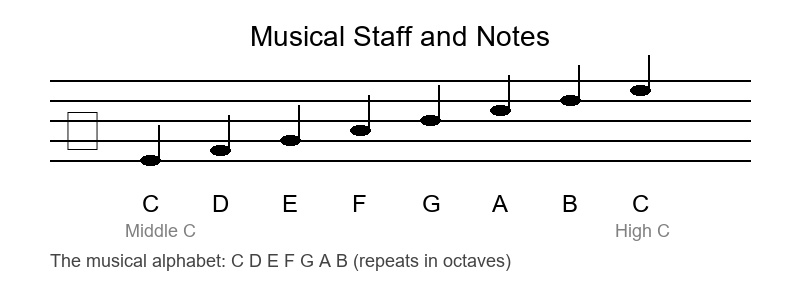
Five lines and four spaces - This is where all musical notes are positioned
Lines (from bottom to top): E, G, B, D, F
Spaces (from bottom to top): F, A, C, E
Essential Components of Sheet Music
Every piece of sheet music contains these core elements:
| Component | Purpose | Example |
|---|---|---|
| Staff | Five horizontal lines where notes are placed | 𝄞 ———————————————————————— |
| Clef | Determines which notes the lines and spaces represent | 𝄞 (Treble) 𝄢 (Bass) |
| Time Signature | Shows the rhythm and meter of the music | 4/4, 3/4, 2/4 |
| Key Signature | Indicates which notes are sharp or flat | ♯ ♭ ♮ |
| Notes | Represent the pitch and duration of sounds | ♩ ♪ ♫ ♬ |
| Bar Lines | Divide music into measures | | | |
Understanding Clefs and Music Note Positions
Clefs are symbols that determine which notes the lines and spaces of the staff represent. There are several types of clefs, each used for different instruments and vocal ranges.
Treble Clef (G Clef)
Used for higher-pitched instruments and voices. The G note is on the second line from the bottom.
Memory Aid: "Every Good Boy Does Fine" (lines) and "FACE" (spaces)
Bass Clef (F Clef)
Used for lower-pitched instruments and voices. The F note is on the fourth line from the bottom.
Memory Aid: "Good Boys Do Fine Always" (lines) and "All Cows Eat Grass" (spaces)
Alto Clef (C Clef)
Used primarily for viola and some vocal music. The C note is on the middle line.
Common Use: Viola, alto voice
Tenor Clef (C Clef)
Used for higher bass instruments like cello and trombone. The C note is on the fourth line from the top.
Common Use: Cello, trombone, bassoon
Note Names on the Staff
Each line and space on the staff represents a specific note. Here's how to identify them:
Treble Clef Notes
Lines (from bottom to top): E, G, B, D, F (Every Good Boy Does Fine)
Spaces (from bottom to top): F, A, C, E (FACE)
Bass Clef Notes
Lines (from bottom to top): G, B, D, F, A (Good Boys Do Fine Always)
Spaces (from bottom to top): A, C, E, G (All Cows Eat Grass)
Understanding Music Note Values and Rhythm
Notes represent both the pitch (how high or low) and the duration (how long) of musical sounds. Understanding note values is crucial for reading rhythm.
Quarter Note
1 beat in 4/4 time
Count: "1"
Eighth Note
1/2 beat in 4/4 time
Count: "1" or "&"
Eighth Note Pair
1 beat total (2 eighth notes)
Count: "1 &"
Sixteenth Notes
1/4 beat each
Count: "1 e & a"
Half Note
2 beats in 4/4 time
Count: "1 2"
Whole Note
4 beats in 4/4 time
Count: "1 2 3 4"
Note Value Relationships
| Note | Symbol | Duration (in 4/4 time) | Equivalent To |
|---|---|---|---|
| Whole Note | 𝅗𝅥 | 4 beats | 4 quarter notes |
| Half Note | 𝅝 | 2 beats | 2 quarter notes |
| Quarter Note | ♩ | 1 beat | 1 beat |
| Eighth Note | ♪ | 1/2 beat | 1/2 quarter note |
| Sixteenth Note | ♬ | 1/4 beat | 1/4 quarter note |
Time Signatures
Time signatures tell you how many beats are in each measure and which note gets one beat. They appear at the beginning of a piece of music and look like a fraction.
Common Time
4 beats per measure
Quarter note = 1 beat
Most popular time signature
Waltz Time
3 beats per measure
Quarter note = 1 beat
Used in waltzes
March Time
2 beats per measure
Quarter note = 1 beat
Used in marches
Compound Time
6 beats per measure
Eighth note = 1 beat
Feels like 2 groups of 3
How to Count in Different Time Signatures
| Time Signature | Beats per Measure | Counting Pattern | Example Music |
|---|---|---|---|
| 4/4 | 4 | 1 2 3 4 | Most pop songs, rock music |
| 3/4 | 3 | 1 2 3 | Waltzes, "Happy Birthday" |
| 2/4 | 2 | 1 2 | Marches, polkas |
| 6/8 | 6 | 1 2 3 4 5 6 | Irish jigs, some ballads |
Key Signatures and Accidentals
Key signatures tell you which notes are sharp or flat throughout the piece. Accidentals are symbols that temporarily change a note's pitch.
Accidentals
Sharp
Raises a note by a half step
Example: C♯ is higher than C
Flat
Lowers a note by a half step
Example: B♭ is lower than B
Natural
Cancels a sharp or flat
Example: B♮ cancels B♭
Common Key Signatures
| Key | Sharps/Flats | Notes Affected | Memory Aid |
|---|---|---|---|
| C Major | None | All natural | No sharps or flats |
| G Major | 1 sharp | F♯ | Father |
| D Major | 2 sharps | F♯, C♯ | Father Charles |
| A Major | 3 sharps | F♯, C♯, G♯ | Father Charles Goes |
| F Major | 1 flat | B♭ | Battle |
| B♭ Major | 2 flats | B♭, E♭ | Battle Ends |
Musical Symbols and Markings
Musical notation includes many symbols that provide additional information about how to play the music.
Dynamics (Volume)
| Symbol | Name | Meaning | Volume Level |
|---|---|---|---|
| pp | Pianissimo | Very soft | Very quiet |
| p | Piano | Soft | Quiet |
| mp | Mezzo Piano | Moderately soft | Medium quiet |
| mf | Mezzo Forte | Moderately loud | Medium loud |
| f | Forte | Loud | Loud |
| ff | Fortissimo | Very loud | Very loud |
Articulation Marks
| Symbol | Name | Effect | How to Play |
|---|---|---|---|
| . | Staccato | Short and detached | Play notes shorter than written |
| — | Tenuto | Hold for full value | Play with emphasis |
| ^ | Accent | Emphasized | Play with more force |
| ~ | Fermata | Hold longer | Hold note beyond its written value |
Different Types of Musical Notation
While standard staff notation is the most common, there are several other types of musical notation used for different purposes.
1. Standard Staff Notation
The traditional five-line staff system used for most Western classical and contemporary music.
Best for: Piano, orchestral instruments, vocal music
2. Tablature (TAB)
Used primarily for stringed instruments like guitar, bass, and ukulele. Shows finger positions rather than pitches.
B|--0--3--0--0--|
G|--0--2--0--0--|
D|--2--0--0--2--|
A|--3--0--2--3--|
E|--0--0--0--0--|
Best for: Guitar, Bass Guitar, Ukulele
3. Numbered Notation
A simplified system using numbers to represent notes, popular in some educational contexts.
Best for: Beginners, some educational systems
4. Chord Charts
Shows chord symbols above lyrics or staff lines, commonly used in popular music.
Best for: Accompaniment, popular music
How to Read Sheet Music - Step by Step Guide
Now that you understand the components, here's how to read a piece of music from start to finish:
Step 1: Identify the Clef
Look at the beginning of the staff to determine which clef is being used. This tells you which notes the lines and spaces represent.
Step 2: Check the Time Signature
Look for the fraction-like numbers after the clef. This tells you how many beats are in each measure and which note gets one beat.
Step 3: Identify the Key Signature
Look for sharps or flats at the beginning of each line. These apply to the entire piece unless cancelled by accidentals.
Step 4: Reading Note Positions
Start from left to right, reading each note's pitch (position on staff) and duration (note value).
Step 5: Observe Musical Markings
Pay attention to dynamics, articulation marks, and other symbols that affect how the music should be played.
Practice Examples with Sheet Music
Let's practice reading some simple melodies:
Example 1: "Mary Had a Little Lamb"
How to Read This Melody (Using Piano as Example):
Key Signature: C Major (no sharps or flats)
Time Signature: 4/4 (four beats per measure)
Clef: Treble clef (𝄞) - indicates this is for higher-pitched instruments
Note-by-Note Breakdown:
- E (Mi): On the first line of the staff - play E4 on piano (white key to the right of the two black keys)
- D (Re): Below the first line - play D4 on piano (white key between the two black keys)
- C (Do): On the ledger line below the staff - play C4 (middle C) on piano
- G (Sol): On the second line of the staff - play G4 on piano (white key to the left of the three black keys)
Piano Fingering for Beginners:
- Right Hand Position: Place thumb on C4, index finger on D4, middle finger on E4, ring finger on F4, pinky on G4
- Finger Numbers: C=1, D=2, E=3, F=4, G=5
- Practice Tip: Start slowly, playing each note clearly before moving to the next
Melody Pattern: E D C D E E E | D D D E G G | E D C D E E E | D D E D C
Example 2: "Ode to Joy" (Beethoven's 9th Symphony)
How to Read This Melody (Using Violin as Example):
Key Signature: D Major (2 sharps: F♯ and C♯)
Time Signature: 4/4 (four beats per measure)
Clef: Treble clef (𝄞) - standard for violin music
Composer: Ludwig van Beethoven (1770-1827)
Violin Fingering and String Positions:
- E5 (Mi): First space on staff - 1st finger on A string (E5 = A4 + 1st position)
- F♯5 (Fa♯): First line on staff - 2nd finger on A string (F♯5 = A4 + 2nd position)
- G5 (Sol): Second space on staff - 3rd finger on A string (G5 = A4 + 3rd position)
- A5 (La): Second line on staff - open A string (A5 = A4 + octave)
- B5 (Ti): Third space on staff - 1st finger on A string (B5 = A4 + 4th position)
- C♯6 (Do♯): Third line on staff - 2nd finger on A string (C♯6 = A4 + 5th position)
- D6 (Re): Fourth space on staff - 3rd finger on A string (D6 = A4 + 6th position)
Violin Technique and Bowings:
- Bow Direction: Down-bow (∨) for strong beats, up-bow (∧) for weak beats
- String Crossing: Stay primarily on A string for this melody
- Intonation: Use your ear to ensure sharp notes (♯) are properly raised
- Vibrato: Apply subtle vibrato on longer notes for musical expression
Musical Analysis:
- Form: Simple binary form (A-B structure)
- Harmony: D Major chord progression: I-V-I-V-I
- Rhythm: Mostly quarter notes with some eighth note patterns
- Dynamics: Start forte (loud), with crescendo possibilities
- Articulation: Legato (smooth) bowing for connected phrases
Historical Context:
This melody comes from the final movement of Beethoven's 9th Symphony (1824), featuring Friedrich Schiller's "Ode to Joy" text. It represents the triumph of human brotherhood and joy, making it one of the most recognizable classical melodies worldwide.
Practice Progression:
- Step 1: Practice the D major scale: D E F♯ G A B C♯ D
- Step 2: Work on string crossings and finger placement
- Step 3: Add bowing patterns and dynamics
- Step 4: Focus on intonation and musical expression
Opening Phrase: E E F♯ G G F♯ E D B B C♯ D D C♯ B A
Memory Aids and Tips
Here are some helpful memory aids to make reading music easier:
Treble Clef Memory Aids
- Lines (bottom to top): "Every Good Boy Does Fine" (E G B D F)
- Spaces (bottom to top): "FACE" (F A C E)
Bass Clef Memory Aids
- Lines (bottom to top): "Good Boys Do Fine Always" (G B D F A)
- Spaces (bottom to top): "All Cows Eat Grass" (A C E G)
Sharp Key Memory Aid
Father Charles Goes Down And Ends Battle (F♯ C♯ G♯ D♯ A♯ E♯ B♯)
Flat Key Memory Aid
Battle Ends And Down Goes Charles' Father (B♭ E♭ A♭ D♭ G♭ C♭ F♭)
Common Mistakes to Avoid
- Confusing clefs: Make sure you're reading the correct clef for your instrument
- Ignoring key signatures: Remember that sharps and flats at the beginning apply to the entire piece
- Rushing through rhythm: Take time to count beats and understand note values
- Overlooking dynamics: Musical expression is just as important as correct notes
- Not practicing regularly: Reading music is a skill that improves with consistent practice
Instrument-Specific Reading Tips
Different instruments have unique considerations when reading music:
Wind Instruments
For instruments like trumpet, flute, saxophone, and clarinet:
- Pay attention to breathing marks and phrase markings
- Consider the instrument's range and transposition
- Practice scales to improve note recognition
String Instruments
For instruments like violin, guitar, and cello:
- Learn finger positions and string names
- Understand bowing directions and techniques
- Practice reading in different positions
Piano and Keyboard
For piano and keyboard instruments:
- Read both treble and bass clefs simultaneously
- Understand chord symbols and accompaniment patterns
- Practice hand coordination and independence
Advanced Reading Music Notes Techniques
Once you've mastered the basics, these techniques will help you become a more fluent music reader:
Sight-Reading Practice
- Practice reading new music daily
- Start with simple pieces and gradually increase difficulty
- Focus on rhythm first, then add pitch
- Don't stop for mistakes - keep the tempo steady
Pattern Recognition
- Look for repeated patterns and sequences
- Identify scales and arpeggios
- Recognize common chord progressions
- Notice phrase structures and musical form
Mental Preparation
- Scan the piece before playing
- Identify key changes and tempo changes
- Look for difficult passages and plan fingerings
- Understand the musical context and style
Conclusion
Learning to read music is a journey that opens up endless possibilities for musical expression and communication. Start with the basics - staff, clefs, and note values - then gradually add more complex elements like key signatures, time signatures, and musical symbols.
Remember that reading music is a skill that improves with practice. Use the memory aids provided, practice regularly with your instrument's fingering chart, and don't be afraid to start with simple pieces. With dedication and consistent practice, you'll soon be reading music fluently and confidently.
🎵 Keep Practicing!
Music reading is a lifelong skill that enhances your musical journey. Whether you're playing trumpet, piano, guitar, or any other instrument, the ability to read music will open doors to countless musical opportunities.
Professional Reference Resources
The following are professional official music education resources and reference websites that can help you further your study of music theory and sheet music reading:
Official Music Education Organizations
- Music Teachers National Association (MTNA) - Professional music education resources and certification from the leading music teachers organization
- International Society for Music Education (ISME) - Global authority on music education, connecting educators worldwide
- MusicTheory.net - Free online music theory lessons and interactive exercises
- Music Theory Academy - Professional music theory learning resources and tutorials
Sheet Music and Music Resource Libraries
- IMSLP (International Music Score Library Project) - Extensive library of free public domain sheet music and scores
- MuseScore - Free music notation software and online sheet music library
- Musicnotes - Official digital sheet music store offering high-quality downloadable scores
- 8notes.com - Free sheet music, music theory, and educational resources
Music Theory and Notation Standards
- MusicXML - Open standard format for representing musical notation, supported by W3C
- SMuFL (Standard Music Font Layout) - Standard specification for music font layout and encoding
- Music Encoding Initiative (MEI) - Digital music encoding standard for scholarly research
Music Conservatories and University Resources
- Berklee College of Music - Premier music college offering online courses and resources
- The Juilliard School - World-renowned performing arts conservatory
- Coursera Music Courses - Online music courses from leading universities worldwide
Professional Music Organizations
- The Recording Academy (GRAMMY) - Prestigious music industry organization behind the GRAMMY Awards
- ASCAP (American Society of Composers, Authors and Publishers) - Leading performing rights organization for music creators
- College Music Society - Academic organization dedicated to music scholarship and education