
Flute Fingering Chart
Interactive fingering demonstration + beginner learning guide + free PDF download
Interactive Flute Fingering Chart
🎵 How to Use This Interactive Chart
Step 1: Choose Key Signature
Select your desired key signature from the dropdown menu. This will show you which notes are sharp or flat in that key.
Step 2: Click on a Note
Click any note button below to see the correct key fingering. The flute diagram will highlight the keys you need to press.
Step 3: Learn the Fingering
Study the highlighted keys on the flute and read the fingering description. Practice until it becomes automatic!
Select a Note
Flute Fingering Chart Image (PRINTABLE)
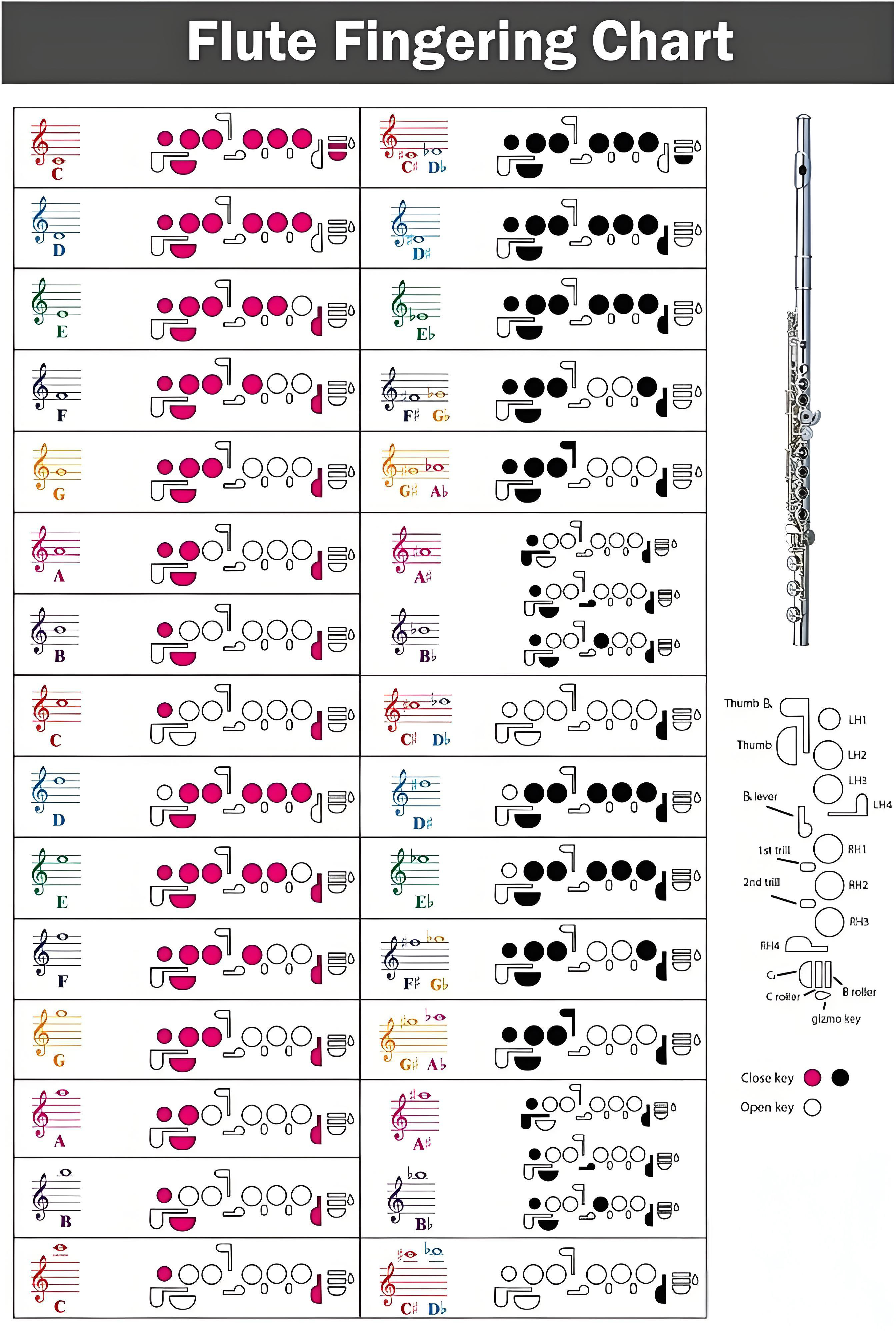
High-quality fingering chart perfect for practice and reference. Download PDF
BEGINNER FLUTE FINGERING CHART
(Standard Flute | C4-C6 Range)
1. Basic Fingerings & Note Chart
| Note | Left Hand | Right Hand | Fingering Description | Octave |
|---|---|---|---|---|
| C | Thumb + 1, 2, 3 | 1, 2, 3, 4 | All fingers down (except L4) | C4, C5, C6 |
| D | Thumb + 1, 2, 3 | 1, 2 | Left 3 fingers, right 2 fingers | D4, D5 |
| E | Thumb + 1, 2, 3 | 1 | Left 3 fingers, right 1 finger | E4, E5 |
| F | Thumb + 1, 2, 3 | — | Left 3 fingers only | F4, F5 |
| G | Thumb + 1, 2 | — | Left 2 fingers only | G4, G5 |
| A | Thumb + 1 | — | Left thumb + index finger | A4, A5 |
| B | Thumb + 2 | — | Left thumb + middle finger | B4, B5 |
| C♯/D♭ | Thumb + 1, 2, 3 | 1, 2, 3 | Left 3 fingers, right 3 fingers | C♯4, C♯5 |
| E♭ | Thumb + 1, 2, 3 | 1, 2, 3 | Left 3 fingers, right 3 fingers | E♭4, E♭5 |
| F♯/G♭ | Thumb + 1, 2 | 1 | Left 2 fingers, right 1 finger | F♯4, F♯5 |
Tip: Left hand fingers: 1=index, 2=middle, 3=ring, 4=pinky. Right hand fingers: 1=index, 2=middle, 3=ring, 4=pinky. Thumb = left thumb key. Cover tone holes completely for clear sound.
2. Essential Beginner Scales
(Practice these scales daily to build finger dexterity and muscle memory)
C Major Scale
C (Thumb+1,2,3, R1,2,3,4) → D (Thumb+1,2,3, R1,2) → E (Thumb+1,2,3, R1) → F (Thumb+1,2,3) → G (Thumb+1,2) → A (Thumb+1) → B (Thumb+2) → C (Thumb)
(Start with C4, then practice C5 octave)
G Major Scale
G (Thumb+1,2) → A (Thumb+1) → B (Thumb+2) → C (Thumb+1,2,3, R1,2,3,4) → D (Thumb+1,2,3, R1,2) → E (Thumb+1,2,3, R1) → F♯ (Thumb+1,2, R1) → G (Thumb+1,2)
(One sharp: F♯)
F Major Scale
F (Thumb+1,2,3) → G (Thumb+1,2) → A (Thumb+1) → B♭ (Thumb+2, R1) → C (Thumb+1,2,3, R1,2,3,4) → D (Thumb+1,2,3, R1,2) → E (Thumb+1,2,3, R1) → F (Thumb+1,2,3)
(One flat: B♭)
D Major Scale
D (Thumb+1,2,3, R1,2) → E (Thumb+1,2,3, R1) → F♯ (Thumb+1,2, R1) → G (Thumb+1,2) → A (Thumb+1) → B (Thumb+2) → C♯ (Thumb+1,2,3, R1,2,3) → D (Thumb+1,2,3, R1,2)
(Two sharps: F♯, C♯)
A Major Scale
A (Thumb+1) → B (Thumb+2) → C♯ (Thumb+1,2,3, R1,2,3) → D (Thumb+1,2,3, R1,2) → E (Thumb+1,2,3, R1) → F♯ (Thumb+1,2, R1) → G♯ (Thumb+1, R1) → A (Thumb+1)
(Three sharps: F♯, C♯, G♯)
3. Simple Practice Melodies
(Great for beginners to practice fingerings and rhythm!)
"Hot Cross Buns" (Traditional):
E (Thumb+1,2,3, R1) → D (Thumb+1,2,3, R1,2) → C (Thumb+1,2,3, R1,2,3,4) → E (Thumb+1,2,3, R1) → D (Thumb+1,2,3, R1,2) → C (Thumb+1,2,3, R1,2,3,4) → C C C C → D D D D → E (Thumb+1,2,3, R1) → D (Thumb+1,2,3, R1,2) → C (Thumb+1,2,3, R1,2,3,4)
(Practice slowly, focusing on clean finger transitions)
"Mary Had a Little Lamb" (Traditional):
E (Thumb+1,2,3, R1) → D (Thumb+1,2,3, R1,2) → C (Thumb+1,2,3, R1,2,3,4) → D (Thumb+1,2,3, R1,2) → E (Thumb+1,2,3, R1) → E (Thumb+1,2,3, R1) → E (Thumb+1,2,3, R1) → D (Thumb+1,2,3, R1,2) → D (Thumb+1,2,3, R1,2) → D (Thumb+1,2,3, R1,2) → E (Thumb+1,2,3, R1) → G (Thumb+1,2) → G (Thumb+1,2) → E (Thumb+1,2,3, R1) → D (Thumb+1,2,3, R1,2) → C (Thumb+1,2,3, R1,2,3,4)
(Perfect for learning basic fingerings)
"Twinkle Twinkle Little Star" (Traditional):
C (Thumb+1,2,3, R1,2,3,4) → C (Thumb+1,2,3, R1,2,3,4) → G (Thumb+1,2) → G (Thumb+1,2) → A (Thumb+1) → A (Thumb+1) → G (Thumb+1,2) → F (Thumb+1,2,3) → F (Thumb+1,2,3) → E (Thumb+1,2,3, R1) → E (Thumb+1,2,3, R1) → D (Thumb+1,2,3, R1,2) → D (Thumb+1,2,3, R1,2) → C (Thumb+1,2,3, R1,2,3,4)
(Practice with steady rhythm and clear notes)
4. Fingering Tips for Beginners
- Keep fingers curved and relaxed—press keys gently, not forcefully.
- Cover tone holes completely—incomplete coverage causes air leaks and poor sound.
- Use the pads of your fingers (not fingertips) on the keys for better coverage.
- Practice finger transitions slowly at first—focus on accuracy before speed!
- Keep your left thumb on the thumb key—it supports the flute and controls the B key.
- Practice scales daily to build muscle memory for common fingerings.
- Use a metronome to maintain steady rhythm while practicing fingerings.
- Remember: proper embouchure (lip position) is just as important as fingerings for producing good sound.
- Keep your wrists relatively straight—avoid bending them too much.
- Practice long tones on each note to develop clear, steady sound production.
Common Flute Fingering Patterns Chart
Here are fundamental fingering patterns to get you started. Mastering these will build a solid foundation. For comprehensive fingering techniques and advanced patterns, explore our detailed Complete Flute Fingering Guide.
| Note/Pattern | Fingering/Position |
|---|---|
| C | Left thumb + first 3 fingers, right first 3 fingers + pinky |
| D | Left thumb + first 3 fingers, right first 2 fingers |
| E | Left thumb + first 3 fingers, right first finger |
| F | Left thumb + first 3 fingers |
| G | Left thumb + first 2 fingers |
| A | Left thumb + first finger |
| B | Left thumb + second finger |
| High C | Left thumb |