
1. How to Use the Free Guitar Scales Diagram
The interactive fretboard above is built to do one job very well: show you every note of any scale, in any key, anywhere on the neck. Whether you are working on a guitar scales solo for the first time or rehearsing a complex jazz line, the workflow is the same.
Step 1 — Pick the Root Note
The Root dropdown controls the tonal center. Choosing E means every shape on the screen is built from the E major, E minor, E pentatonic or E blues scale. Sharps are written as sharps (C#) with the flat equivalent shown next to it (Db), so you can read either way.
Example: set Root to A. You are now looking at an A minor pentatonic, the single most-used scale in rock lead guitar.
Step 2 — Pick the Scale Type
The Scale dropdown switches the interval pattern. The most common starting points are:
- Major (Ionian) — the cheerful do-re-mi-fa-sol-la-ti-do of Western music. Use it for lead lines over major-key progressions.
- Natural Minor (Aeolian) — the same notes starting on the sixth degree of the major scale. Slightly darker, the backbone of rock, metal and modal soloing.
- Major Pentatonic — five notes per octave, bright and clean. Excellent for country, folk, pop and classic-rock melodies.
- Minor Pentatonic — five notes per octave, the workhorse of blues, rock and pop soloing. Every classic-rock guitar solo you have heard sits in a minor pentatonic.
- Blues — the minor pentatonic plus one “blue note” (b5). Instantly recognizable as the sound of the Mississippi Delta and Chicago blues.
Example: set Scale to Major Pentatonic. The diagram will highlight five notes per octave across the neck — the simplest, most forgiving scale in the entire system.
Step 3 — Read the Diagram
Each dot on the fretboard is one playable note:
- Root notes are drawn as darker, larger circles.
- Other scale tones are drawn in the lighter accent color.
- Note names appear inside the dots (toggle off if you only want the pattern).
- Scale degrees (1, 2, 3, …) appear instead when you check Show scale degrees.
Strings run with the low E string at the bottom and the high E string at the top. Frets run left to right; the nut is on the left and fret 0 means an open string.
Step 4 — Connect the Dots on the Guitar
Pick a comfortable shape (start with the area between frets 5 and 10) and play the dots in order, ascending then descending, with alternate picking. When you can play one shape cleanly at 80 BPM, move on to combining it with the next shape up the neck. The diagram makes the geometric link between shapes visible, which is the single hardest skill in scale mastery.
Step 5 — Reset for a Clean View
Click the Reset to C Major button to return to the default starting point whenever the screen feels overwhelming.
Worked Example: The G Major Scale on Guitar
Let us walk through one full workflow, end to end.
- Set Root = G, Scale = Major.
- Look at the highlighted pattern between frets 3 and 7. It includes the open G on the 3rd string, the B on the 2nd string (fret 0), and the D on the 1st string (fret 3).
- Read the dots in order from low to high. They will spell out G–A–B–C–D–E–F#–G.
- Play that pattern ascending and descending with alternate picking. Once it feels smooth, play the same shape in the key of C major and notice how every dot shifts two frets to the left.
That single exercise — learn a shape, transpose it by ear — is the core of every guitar scales practice routine.
2. Pentatonic Scale Guitar — The Five-Note Foundation
The pentatonic scale guitar family is the single most important scale system in popular music. “Penta” means five and “tonic” means tone, so a pentatonic scale contains exactly five different notes per octave. Two flavors exist:
- Major pentatonic: 1 – 2 – 3 – 5 – 6 (skip the 4th and 7th).
- Minor pentatonic: 1 – b3 – 4 – 5 – b7 (skip the 2nd and 6th).
Both are forgiving because they leave out the two notes most likely to clash against a simple chord progression. Country, folk, blues, classic rock, modern worship, and pop lead vocals are all built on pentatonic shapes.
Pentatonic Box 1 in E Minor (the universal first shape)
Set Root = E and Scale = Minor Pentatonic, then look between frets 0 and 3. The highlighted pattern below is the most-used lead-guitar shape in the world.
E (low)  |--0--|--|--3--|
A        |--0--|--2--|--3--|
D        |-----|--2--|--3--|
G        |--0--|--2--|--3--|
B        |--0--|--2--|-----|
E (high) |--0--|--|--3--|
            0    1    2    3
                       E minor pentatonic, Box 1
   Notes:    E - G - A - B - C - D - E
   Degrees:  1   b3  4   5   b7  1
How to Play the E Minor Pentatonic Box 1
- 1st finger (index): place it at the nut. The open low E string is the root E — let it ring.
- 3rd finger (ring): press the A string at fret 2 — that note is B, the 4th of the scale.
- 4th finger (pinky): press the A string at fret 3 — that note is C, the b7.
- Slide your hand up so 1st finger is on fret 2 of the D string (E, the octave root) and walk through the rest of the box with the 3rd and 4th fingers.
- Use alternate picking (down-up-down-up) so every note rings cleanly. Practice the box ascending then descending.
- Once fluent, try hammer-ons and pull-offs between the 3rd and 4th fingers on the high strings to add the classic bluesy feel.
3. C Major Scale Guitar — The All-Natural Starting Point
The C major scale guitar is the easiest major scale to read because it uses no sharps and no flats. Every note is a white-key on the piano: C–D–E–F–G–A–B–C. Learning it on the fretboard teaches you the geometry of the standard 3-notes-per-string major scale shape used for every other key.
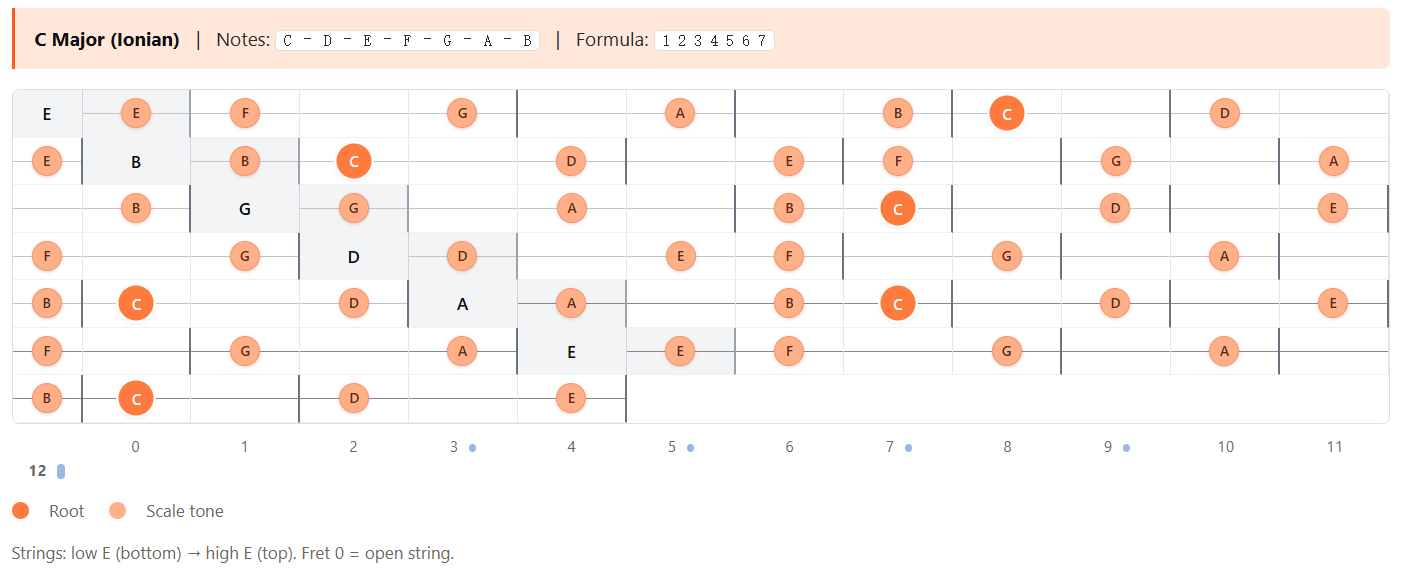
The C Major Scale, Open Position
Set Root = C and Scale = Major. Below is the open-position pattern between frets 0 and 5.
E (low)  |--0--|--1--|--3--|
B        |-----|--1--|--3--|
G        |-----|--0--|--2--|
D        |-----|--2--|--3--|
A        |--0--|-----|--3--|
E (high) |--0--|--1--|--3--|
            0     1     2     3
                       C major, open position
   Notes:    E - F - G - A - B - C - D - E
   Degrees:  3   4   5   6   7   1   2   3
How to Play C Major on Guitar (Open Position)
- Low E string: play the open E (the 3rd of the scale), then 1st finger on fret 1 (F) and 3rd finger on fret 3 (G).
- A string: open A (the 6th of the scale), then 3rd finger on fret 3 (C, the octave root).
- D string: 3rd finger on fret 2 (E, the 3rd, octave above) and 4th finger on fret 3 (F, the 4th).
- G string: open G (the 5th) and 3rd finger on fret 2 (A, the 6th).
- B string: 1st finger on fret 1 (C, the octave) and 3rd finger on fret 3 (D, the 2nd of the scale).
- High E string: open E (3rd), 1st finger on fret 1 (F) and 3rd finger on fret 3 (G, the 5th octave above the root).
- Practice the entire shape slowly with a metronome at 60 BPM. Aim for one note per click ascending and descending.
4. E Major Scale Guitar — Open Strings Shine
The E major scale guitar pattern is a guitarist’s best friend because it uses four open strings, which gives the scale a ringing, jangly tone. The scale uses four sharps: F#, G#, C# and D#. If you already know the E minor pentatonic, this shape will feel familiar — you are simply adding two notes (G# and D#).
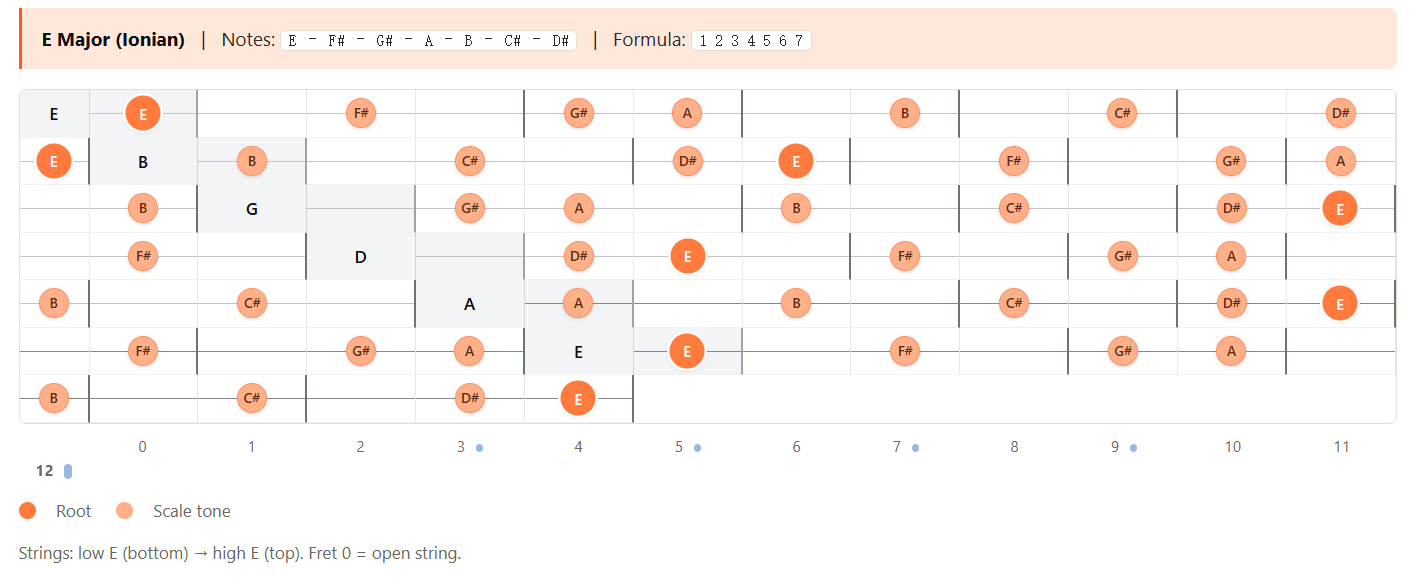
The E Major Scale, Open Position
Set Root = E and Scale = Major. The pattern lives between frets 0 and 4.
E (low)  |--0--|--2--|--4--|
B        |--0--|--2--|--4--|
G        |--1--|--4--|
D        |--2--|--4--|
A        |--2--|--4--|
E (high) |--0--|--2--|--4--|
            0     1     2     3     4
                       E major, open position
   Notes:    E - F# - G# - A - B - C# - D# - E
How to Play E Major on Guitar
- Start with the open low E string. This is the root.
- Place your 2nd finger on fret 2 (F#) and your 4th finger on fret 4 (G#).
- Move to the A string: 2nd finger on fret 2 (B) and 4th finger on fret 4 (C#).
- Continue on the D string: 2nd finger on fret 2 (E, the octave) and 4th finger on fret 4 (F#).
- On the G string: 1st finger on fret 1 (G#) and 3rd finger on fret 4 (C#).
- On the B string: 1st finger on fret 0 (open B) and 2nd finger on fret 2 (C#), then 4th finger on fret 4 (D#).
- End on the high E string: open E (the root, an octave above where you started), then 2nd finger on fret 2 (F#) and 4th finger on fret 4 (G#).
- Practice slowly, then experiment with country-style “chicken pickin’” by muting unused strings with the palm of your picking hand.
5. D Major Scale Guitar — Folk and Country Standard
The D major scale guitar shape lives entirely between frets 0 and 5 and uses two open strings (D and A), making it a folk and country favorite. The scale uses two sharps: F# and C#. D major is the relative major of B minor, so learning one helps the other stick.
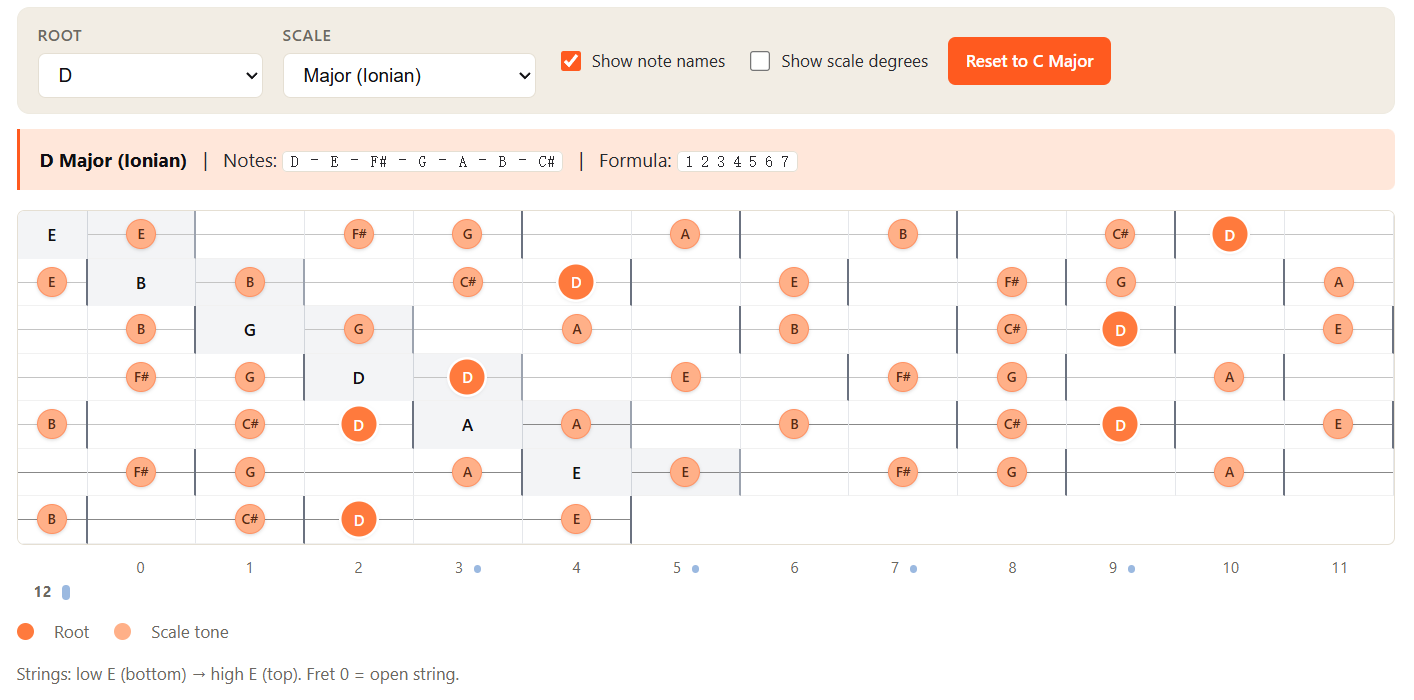
The D Major Scale, Open Position
Set Root = D and Scale = Major. Below is the four-fret open-position shape.
E (low)  |------|--2--|--4--|
B        |------|--3--|--5--|
G        |------|--2--|--4--|
D        |--0--|--2--|--4--|
A        |--0--|--2--|--4--|
E (high) |------|--2--|--4--|
            0     1     2     3     4     5
                       D major, open position
   Notes:    D - E - F# - G - A - B - C# - D
How to Play D Major on Guitar
- Start with the open D string (lowest note you should play — skip the low E and A string when descending past the D string).
- Place 1st finger on fret 2 (E) and 3rd finger on fret 4 (F#).
- Move to the G string: 1st finger on fret 2 (A) and 3rd finger on fret 4 (B).
- Continue on the B string: 1st finger on fret 3 (D, the octave) and 3rd finger on fret 5 (E).
- On the high E string: 1st finger on fret 2 (F#) and 3rd finger on fret 4 (G).
- Reverse the pattern to descend, ending on the open D string. Keep the unused strings muted with the side of your 1st finger to prevent them from ringing out.
- Once smooth, add the open A string at the end of the descending pattern to create the classic D major arpeggio sound.
6. A Minor Scale in Guitar — The Natural Minor Key
The A minor scale in guitar is the most-used natural-minor pattern in popular music because it shares the same notes as C major (no sharps, no flats) but starts on A. Open-position A minor pentatonic is Box 1 of pentatonic guitar, so this scale is also the bridge between the pentatonic and the full diatonic system.
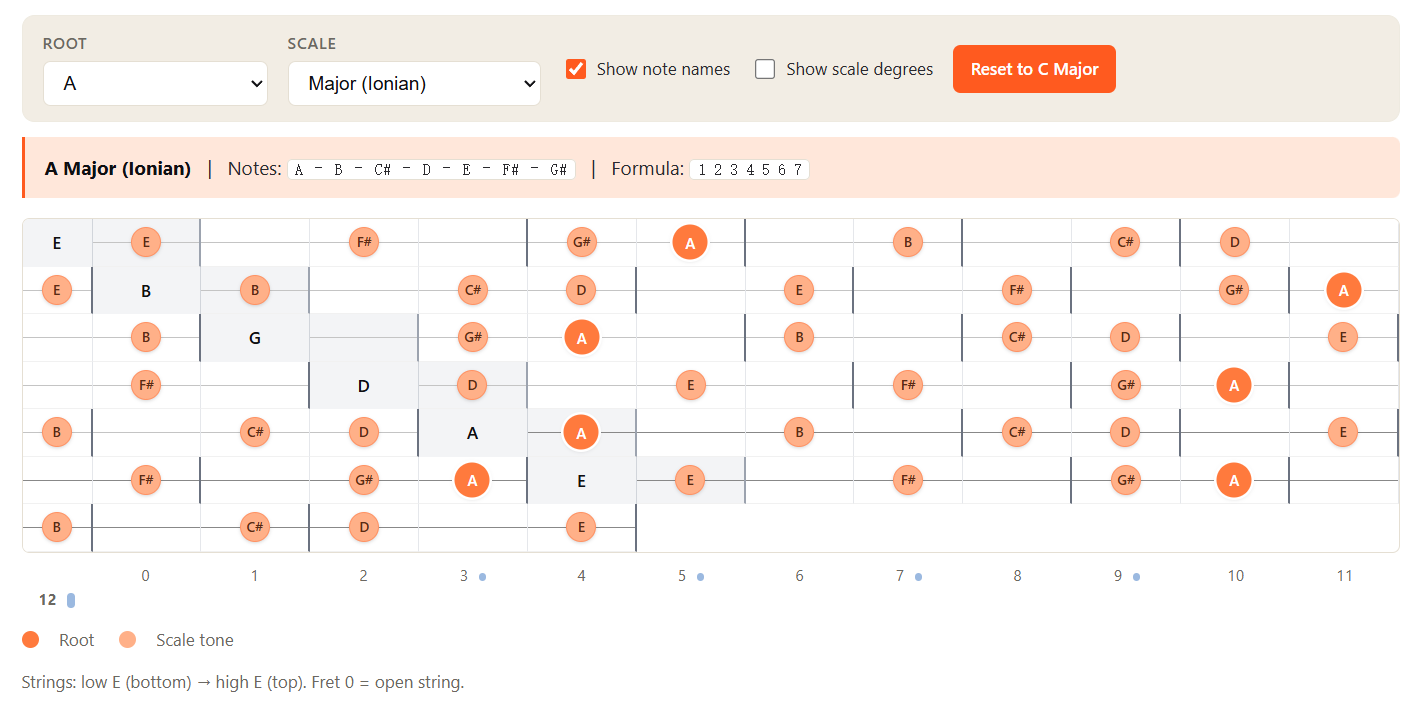
The A Natural Minor Scale, Open Position
Set Root = A and Scale = Natural Minor (Aeolian). Below is the open-position shape between frets 0 and 5.
E (low)  |--0--|--|--3--|--5--|
B        |--0--|--|--3--|------|
G        |------|--2--|--5--|------|
D        |------|--2--|--5--|------|
A        |--0--|--2--|--3--|------|
E (high) |--0--|--|--3--|--5--|
            0     1     2     3     4     5
                       A minor, open position
   Notes:    A - B - C - D - E - F - G - A
   Degrees:  1   2   b3  4   5   b6  b7  1
How to Play A Natural Minor on Guitar
- Start with the open low E string (E, the 5th of the scale). Place 1st finger on fret 3 (G, the b7) and 3rd finger on fret 5 (A, the octave root).
- Move to the A string: open A (root), then 1st finger on fret 2 (B, the 2nd) and 3rd finger on fret 3 (C, the b3).
- Continue on the D string: 1st finger on fret 2 (E, the 5th) and 3rd finger on fret 5 (F, the b6).
- On the G string: 1st finger on fret 2 (A, the octave) and 3rd finger on fret 5 (C, the b3 octave above).
- On the B string: open B (the 2nd), 3rd finger on fret 3 (D, the 4th).
- Finish on the high E string: open E (5th), 1st finger on fret 3 (G, the b7) and 3rd finger on fret 5 (A, the octave above the root).
- Try playing it as a single melodic line over an Am–Dm–Em–Am chord progression. The shape fits the harmony perfectly.
7. F Major Scale Guitar — Mastering the Barres
The F major scale guitar pattern is the first scale most players learn that requires a barre. F major has one flat: Bb. Because the open-position shape is awkward, most guitarists learn the E-shape barre at the 1st fret, then later move to a movable 3-notes-per-string pattern starting at the 1st fret.
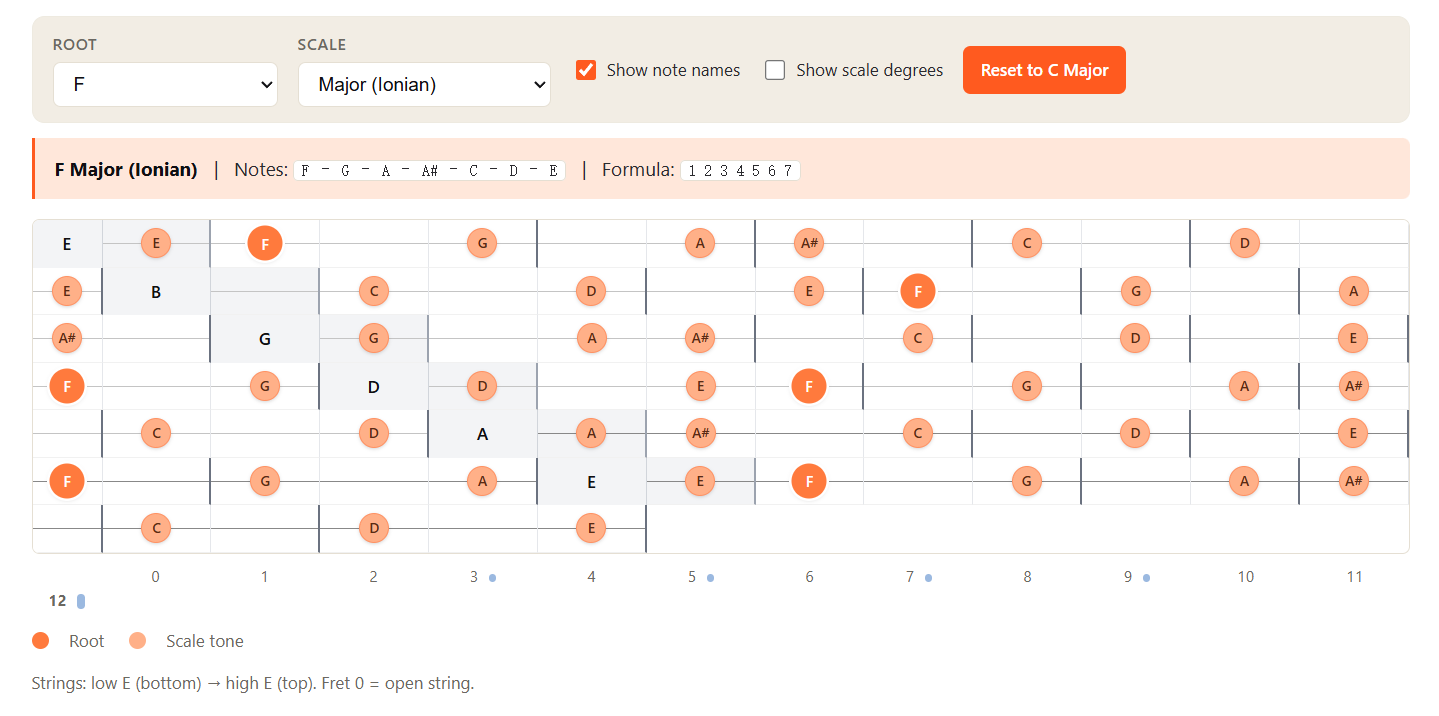
The F Major Scale, E-Shape Barre at Fret 1
Set Root = F and Scale = Major. The pattern below uses a full barre across the 1st fret.
E (low)  |--1--|--3--|--5--|--6--|--8--|
B        |--1--|--3--|--5--|--6--|--8--|
G        |--1--|--3--|--5--|--6--|--8--|
D        |--3--|--5--|--6--|--8--|
A        |--3--|--5--|--6--|--8--|
E (high) |--1--|--3--|--5--|--6--|--8--|
            1     2     3     4     5     6     7     8
                       F major, E-shape barre
   Notes:    F - G - A - Bb - C - D - E - F
How to Play F Major on Guitar
- Barre your 1st finger flat across every string at fret 1. Press firmly, especially on the low E and A strings.
- Add your 3rd finger on fret 3 (G) and your 4th finger on fret 5 (A) on the low E string, then mirror it on the A and D strings.
- On the G, B and high E strings, place the same notes (fret 3 = A, fret 5 = Bb, fret 6 = C) using a combination of the 3rd and 4th fingers.
- Continue up the neck using the standard E-shape pattern: fret 8 = F (the octave above the root).
- Reverse the shape to descend, maintaining the barre throughout. If the barre buzzes, angle your finger slightly toward the headstock to use the stronger side of the finger.
- Once comfortable, practice the same shape moved up to fret 3 to play G major, then fret 5 for A major — one shape, three keys.
8. G Scale Guitar — The Classic Rock & Blues Foundation
The G scale guitar pattern in open position uses one sharp (F#). It is one of the most-used scales in country, folk and classic rock because it shares so many open-string-friendly shapes with G major chord voicings. It is also the parent scale of the G major pentatonic and the E minor pentatonic.
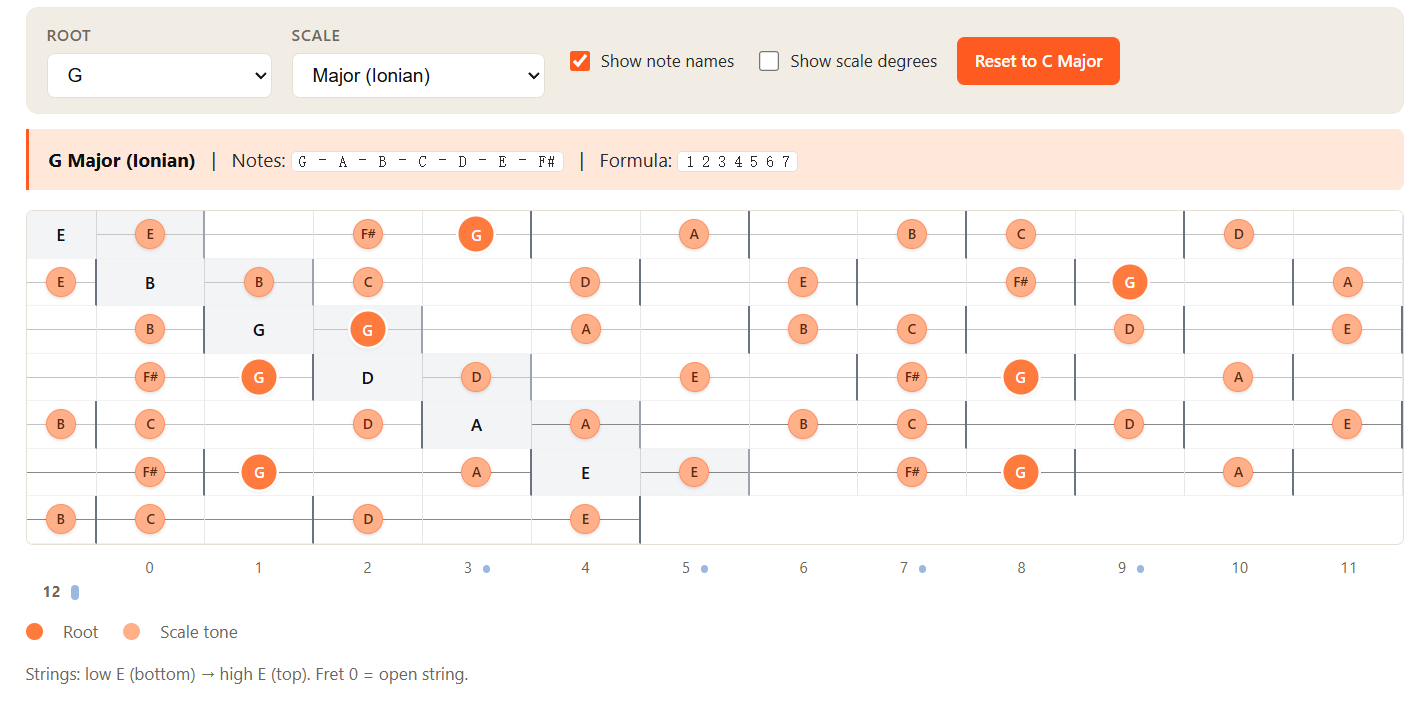
The G Major Scale, Open Position
Set Root = G and Scale = Major. The shape below sits between frets 0 and 5.
E (low)  |--3--|--5--|
G        |--0--|--2--|--4--|
B        |--0--|--2--|--4--|
D        |--0--|--2--|--4--|
A        |--2--|--4--|
E (high) |--3--|--5--|
            0     1     2     3     4     5
                       G major, open position
   Notes:    G - A - B - C - D - E - F# - G
How to Play G Major on Guitar
- Start with the open G string (the lowest note of the shape). This is the root.
- Place 1st finger on fret 2 (A) and 3rd finger on fret 4 (B) on the G string.
- Continue on the B string: open B (the 3rd of the scale) and 1st finger on fret 2 (C) and 3rd finger on fret 4 (D).
- On the D string: open D (the 5th), then 1st finger on fret 2 (E) and 3rd finger on fret 4 (F#, the only sharp).
- On the A string: 1st finger on fret 2 (B) and 3rd finger on fret 4 (C).
- Finish on the high E string: 1st finger on fret 3 (G, the octave) and 3rd finger on fret 5 (A).
- Use this scale over the classic I–IV–V progression G–C–D. Every phrase built from this shape will sound like classic rock.
9. B Minor Scale Guitar — The Emotional Center
The B minor scale guitar is the relative minor of D major (two sharps: F# and C#) and the home key of countless ballads, modal rock solos and emotional lead lines. B minor shares the same set of notes as D major, so learning it gives you two scales for the price of one fingering.
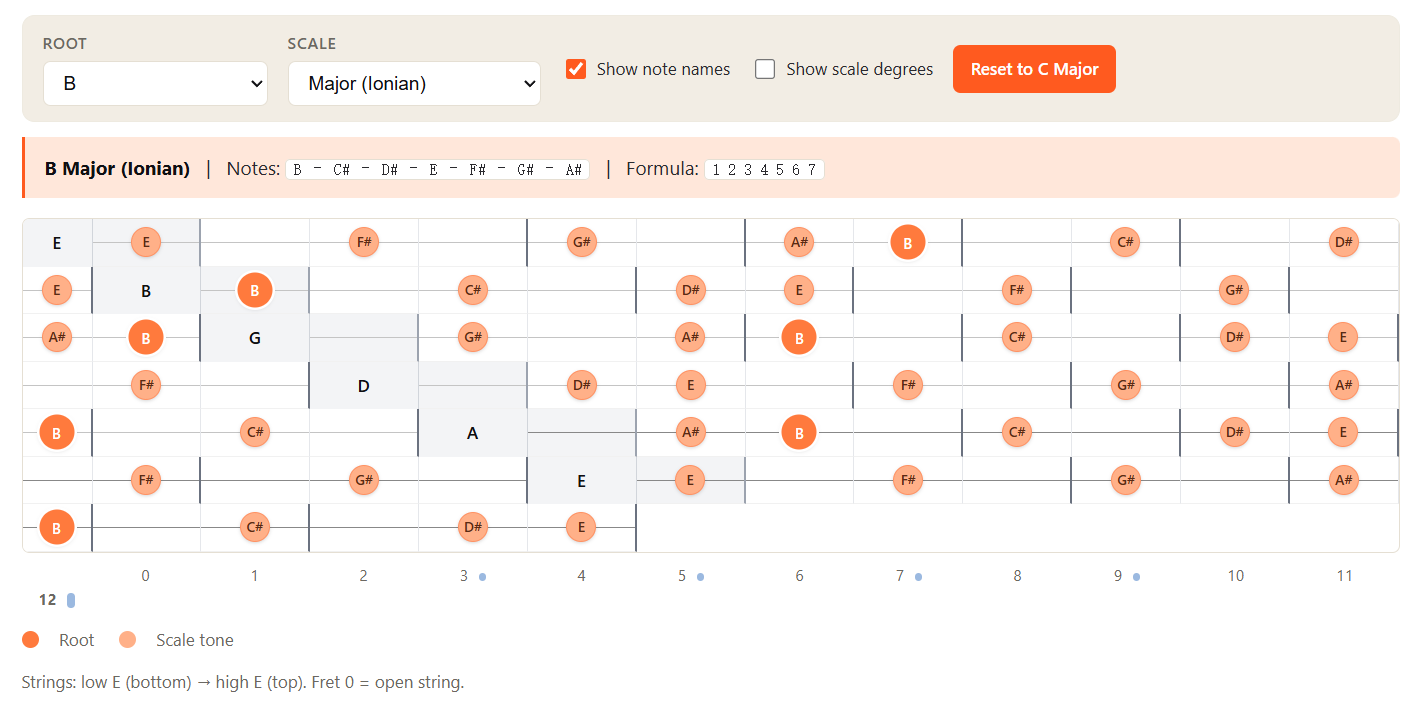
The B Natural Minor Scale, Open Position
Set Root = B and Scale = Natural Minor (Aeolian). The shape below lives between frets 2 and 7.
E (low)  |------|--2--|--4--|
B        |--2--|--4--|--5--|
G        |------|--4--|--7--|
D        |------|--4--|--7--|
A        |------|--2--|--4--|
E (high) |------|--2--|--4--|
            2     3     4     5     6     7
                       B minor, open position
   Notes:    B - C# - D - E - F# - G - A - B
   Degrees:  1   2   b3  4   5   b6  b7  1
How to Play B Natural Minor on Guitar
- A string: 1st finger on fret 2 (B, the root) and 3rd finger on fret 4 (C#, the 2nd).
- Continue on the D string: 1st finger on fret 4 (F#, the 5th of the scale) and 3rd finger on fret 7 (A, the b7).
- On the G string: 1st finger on fret 4 (B, the octave) and 3rd finger on fret 7 (D, the 4th).
- On the B string: 1st finger on fret 2 (C#, the 2nd), 3rd finger on fret 4 (D, the 4th) and 4th finger on fret 5 (E, the perfect 5th).
- On the high E string: 1st finger on fret 2 (F#, the 5th) and 3rd finger on fret 4 (G, the b6).
- Finally, on the low E string: 1st finger on fret 2 (F#, the 5th) and 3rd finger on fret 4 (G, the b6).
- Practice slowly over a Bm–G–D–A progression to feel how each note relates to the underlying harmony. The shape is the same as the D major scale, just starting on the 6th degree.
10. A Quick Reference of All Major Scale Open-Position Shapes
For convenience, the table below lists the open-position major scale shape for every key. All of them are playable on a standard-tuned guitar, although some (such as F major and B major) require a barre.
| Key | Accidentals | Notes (1–7) | Lowest Open Root? | Barre Required? |
|---|---|---|---|---|
| C | None | C – D – E – F – G – A – B | Yes | No |
| G | F# | G – A – B – C – D – E – F# | Yes | No |
| D | F#, C# | D – E – F# – G – A – B – C# | Yes | No |
| A | F#, C#, G# | A – B – C# – D – E – F# – G# | Yes | No |
| E | F#, C#, G#, D# | E – F# – G# – A – B – C# – D# | Yes | No |
| F | Bb | F – G – A – Bb – C – D – E | No | Yes (fret 1) |
| Bb | Bb, Eb | Bb – C – D – Eb – F – G – A | No | Yes (fret 1) |
| Eb | Eb, Ab, Bb | Eb – F – G – Ab – Bb – C – D | No | Yes (fret 1) |
| B | F#, C#, G#, D#, A# | B – C# – D# – E – F# – G# – A# | No | Yes (fret 2) |
11. Practice Routine: Five Steps to Mastery
- Pick one key per week. Use the interactive diagram above to learn the open-position shape for that key.
- Play it ascending and descending with a metronome at 60 BPM for five minutes a day. Aim for even timing, not speed.
- Sing each note name out loud as you play it. The connection between ear, voice and finger is what eventually turns a scale into music.
- Apply it to a backing track. Search for a backing track in the same key on YouTube (search: “[key] major backing track”). Solo over it using only the scale you just learned.
- Move up the neck. After one week on the open position, learn the next three-notes-per-string pattern up the neck (fret 5 onwards for E-shape keys).
12. Frequently Asked Questions
What is a guitar scale?
A guitar scale is an ordered series of notes, ascending or descending in pitch, that follows a defined interval recipe. The most common scales are built from seven notes (major and minor) or five notes (pentatonic). Scales are the raw vocabulary of melody and improvisation.
Which scale should a beginner learn first?
Start with the minor pentatonic in E (Box 1, frets 0–3). It uses one easy shape, sounds great over the most common chord progressions, and is the foundation of every rock and blues lead line you have ever heard.
How do I read the interactive fretboard diagram?
Pick a root note from the first dropdown, then a scale type from the second. The diagram instantly highlights every playable scale note across a 15-fret neck. Root notes are darker, scale tones are lighter. Toggle “Show note names” or “Show scale degrees” to control what is written inside the dots.
Why does the same scale have multiple shapes?
Every scale can be played in several fretboard positions. These overlapping shapes are often called “CAGED” boxes or pentatonic boxes. Connecting them lets you move up and down the neck and reach the highest or lowest note of a phrase wherever your hand happens to be.
How long does it take to learn all the major scale shapes?
With 15 minutes of daily practice, the seven 3-notes-per-string major scale patterns are learnable in about three months. Adding the five pentatonic box shapes brings total fluency to about six months. Consistency matters far more than duration — ten minutes every day beats an hour on Saturday.
Should I learn notes or scale degrees first?
Learn both, in parallel. Knowing the note name (E, G, A) is essential for reading tab and chord charts. Knowing the scale degree (1, b3, 5) is essential for understanding why the note sounds good over a particular chord. Toggle between the two views in the interactive diagram above to drill both.
Conclusion
Scales are the alphabet of guitar lead playing. The interactive fretboard turns that alphabet into something you can see, hear and practice. Pick a key, pick a scale, work the shape with a metronome, then solo over a backing track in the same key. That cycle — visualise, practise, apply — is the engine of every guitar player who has ever moved from beginner to confident improviser.
For more guitar resources, see our Guitar Fingering Chart and our printable Guitar Fingering Chart PDF.