
Music theory can sound intimidating if your only exposure has been a conservatory lecture hall, but the truth is far friendlier. Whether you want to sing in tune, jam at a piano, or understand why your favorite pop song makes you feel something, a working knowledge of basic music theory makes music come alive in your ears. This beginner's guide walks you through the building blocks one step at a time, with diagrams that turn abstract terms into things you can actually see.
1. How Sound Works: The Foundation of Everything
Every sound you hear starts with the same three ingredients: a vibrating object, a medium (usually air), and a receiver (your ear). Pluck a guitar string, and the string vibrates; the air carries that vibration to your eardrum, which vibrates in sympathy, and your brain interprets the result as sound.
From there, musicians split sounds into two broad categories:
- Tone (musical sound): A regular, periodic vibration with a definite pitch. Press a key on a piano and you always get the same frequency: C is always C.
- Noise: An irregular, non-periodic vibration with no definite pitch. A hand clap or a cymbal crash falls into this category.
To describe what makes a tone sound the way it does, we use four perceptual qualities:
- Pitch: How high or low the sound feels (frequency)
- Duration: How long the sound lasts (time)
- Loudness: How strong the sound feels (amplitude)
- Timbre: The "color" of the sound (the shape of its waveform)
Every later topic in music theory is essentially a different way of arranging these four dimensions.
2. The Musical System and the Seven Note Letters
A musical system is the sum of all tones a piece of music draws from. At the heart of every Western system sit seven notes with independent names:
C - D - E - F - G - A - B
Their solfege syllables, the ones you probably sang in school, are:
do - re - mi - fa - sol - la - si
Think of note names as ID numbers and solfege syllables as nicknames. The note name stays the same in every country (C is always C), while solfege in fixed-do systems stays as do-re-mi regardless of the key. This single correspondence is the first gate to entering basic music theory.
3. Clefs: The Treble G and the Bass F
Once you have seven notes, you need a way to anchor them on the staff. That is what clefs do: each one sets a reference pitch on a specific line.
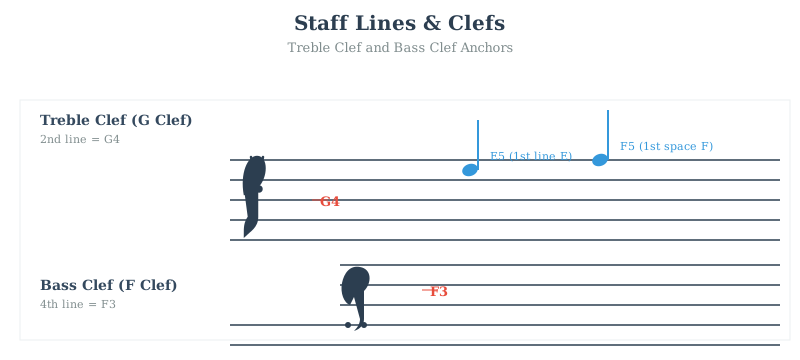
- Treble clef (G clef): Wraps its spiral around the second line from the bottom, declaring that line to be G4 (the G above middle C). This clef carries most melodic lines, children's voices, and high instruments such as the violin and flute.
- Bass clef (F clef): The two dots hug the fourth line, marking it as F3. It covers the lower ranges used by the piano's left hand, the cello, the bassoon, and the tuba.
Piano music uses both clefs at once: the treble for the right hand and the bass for the left, connected by a brace. This is why so many beginners feel overwhelmed at the keyboard; they are not just reading one staff, they are juggling two coordinate systems at the same time. For a step-by-step walkthrough of every symbol on the staff (and how to read your first piece from cover to cover), see our complete How to Read Sheet Music guide.
4. Accidentals: Sharp, Flat, Double Sharp, Double Flat, Natural
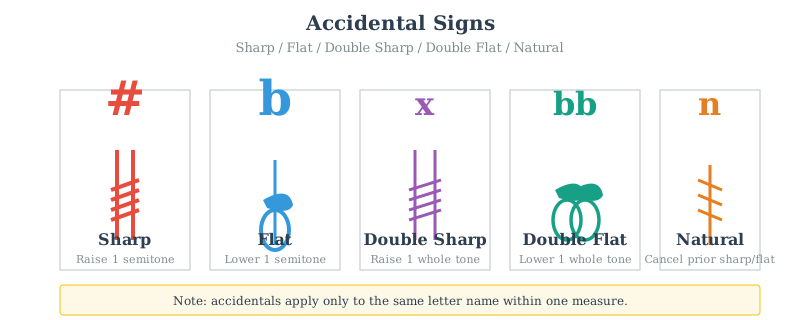
Seven letters are not enough because music uses every "in-between" pitch as well. Accidentals take care of those notes.
| Symbol | Name | Effect |
|---|---|---|
| # | Sharp | Raises the pitch by one semitone |
| b | Flat | Lowers the pitch by one semitone |
| x | Double sharp | Raises the pitch by one whole tone |
| bb | Double flat | Lowers the pitch by one whole tone |
| n | Natural | Cancels a previous sharp or flat |
Important rule: An accidental only affects the same letter name within the same measure. As soon as the next bar starts, the accidental automatically expires unless it is written again. Forgetting this rule is the most common cause of wrong notes when sight-reading.
5. Range and Registers: How Wide Can a Piano Go?
Range is the full spread from the lowest to the highest note an instrument or voice can produce. Register is a human-made sub-division of that range into height zones.
- Total pitch range: C2 to C5 (a reference range used in most pedagogical charts).
- Standard piano range: A2 to C5. The 88-key piano covers seven full octaves plus three extra notes: A2, B2, and the final C5.
Knowing the rough size of a piano's range makes every score make more sense. The moment you see "small C on the second line," you will know exactly where to look.
6. Semitones and Whole Tones: The 12-Tone Equal Temperament Engine
Two concepts underpin nearly everything in modern music: the semitone and the whole tone. They are the smallest building blocks of the 12-tone equal temperament system used by virtually every Western instrument today.
A whole tone equals two semitones, and each type splits further:
Whole tone (whole step):
- Diatonic whole tone: Between two adjacent natural letter names, such as C-D, D-E, F-G, G-A, or A-B.
- Chromatic whole tone: Between two versions of the same letter name or between letters a step apart, such as C-bD or E-#F.
Semitone (half step):
- Diatonic semitone: Between two adjacent natural letter names with no black key between them on the piano: E-F or B-C.
- Chromatic semitone: Between two versions of the same letter name, such as C-#C or E-bF.
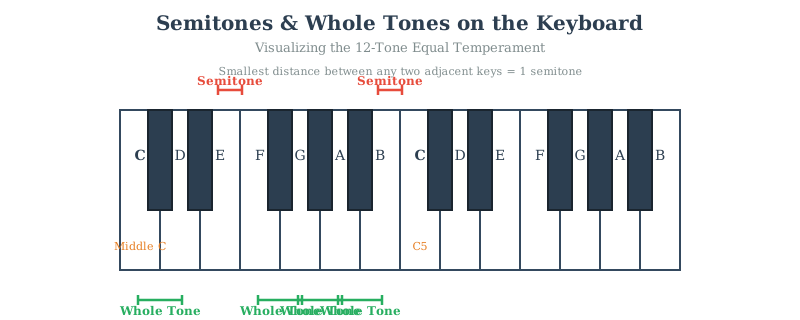
A simple visual rule: on a piano keyboard, any two adjacent keys (including black keys) are one semitone apart. White keys with no black key between them (E-F and B-C) are already a semitone, while every other pair of adjacent white keys has a black key in between and counts as a whole tone. This single rule applies to every equal-tempered instrument.
7. Naming the Octaves: Small Letters and Big Letters
Octave designations confuse almost every beginner. The system is just a way to label which C you are talking about.
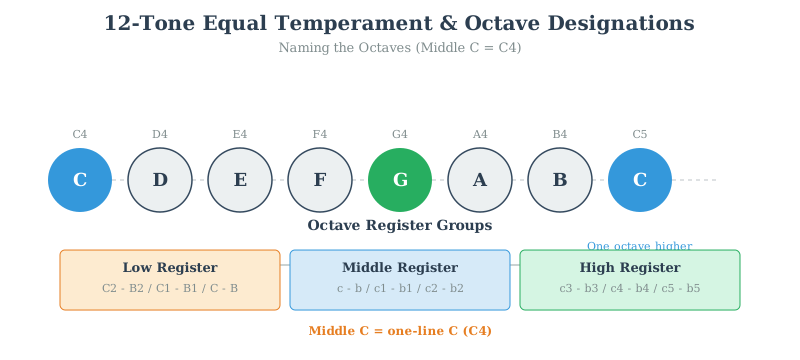
- Low register: Great octave group 2 (C2-B2), great octave group 1 (C1-B1), great octave (C-B).
- Middle register: Small octave (c-b), one-line octave (c1-b1), two-line octave (c2-b2).
- High register: Three-line octave (c3-b3), four-line octave (c4-b4), five-line octave (c5-b5).
Middle C is one-line C (C4). It is the anchor of the entire system. On a piano, it is the C you can see sitting almost in the middle of the keyboard.
8. Rhythm and Meter: The Skeleton of Music
If pitch is the flesh of music, rhythm is its skeleton. Three terms form the foundation:
- Rhythm: How long each note lasts, in beats and fractions of beats.
- Meter: How strong and weak beats alternate to shape the pulse.
- Time signature: The notation at the start of a piece that tells you both the beat unit and how many beats per measure. For example, 2/4 means "a quarter note gets one beat, and there are two beats per measure."
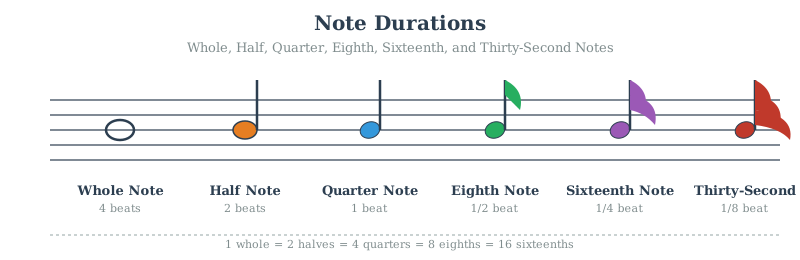
A few useful recognition rules for note durations:
- Whole note: An open oval with no stem.
- Half note: An open oval with a stem but no flag.
- Quarter note: A filled oval with a stem but no flag.
- Eighth note: A filled oval with a stem and one flag.
- Sixteenth note: A filled oval with a stem and two flags.
- Thirty-second note: A filled oval with a stem and three flags.
The math to remember is: 1 whole = 2 halves = 4 quarters = 8 eighths = 16 sixteenths.
Here are the three time signatures that cover about 80 percent of the pop music you will hear:
| Time Signature | Strong-Weak Pattern | Common Style |
|---|---|---|
| 2/4 | STRONG-weak / STRONG-weak | Marches, polkas |
| 3/4 | STRONG-weak-weak / STRONG-weak-weak | Waltzes |
| 4/4 | STRONG-weak-SECONDARY-weak / STRONG-weak-SECONDARY-weak | Pop, rock, jazz |
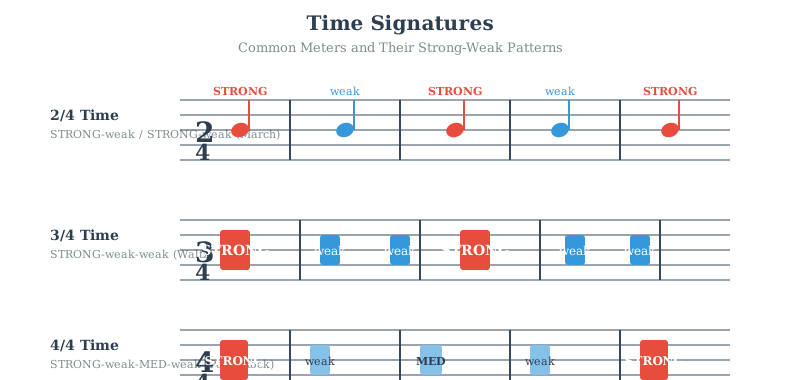
3/4 feels like a waltz because the strong-weak-weak cycle matches the three-step foot pattern. 4/4 has an extra secondary strong beat that gives it room to host more complex rhythms, which is why it became the default for popular music.
The Six Families of Meter
Meters come in more shapes than the three above:
- Simple meter: All duple and triple meters, the most basic group.
- Compound meter (same beat groupings): Two or more single meters of the same type added together, such as 4/4 = 2/4 + 2/4.
- Mixed meter (different beat groupings): Single meters of different types combined, such as 5/4 = 2/4 + 3/4.
- Changing meter: Two or more different time signatures appearing one after another. Jazz loves this.
- Poly-meter: Two or more different time signatures sounding at the same time.
- Free meter: No fixed pattern of strong and weak beats, as in free recitative and much East Asian traditional music.
Master simple meters first, then layer in the others as your reading improves.
9. The Three Ingredients of Melody
Melody moves us because it weaves together three elements: how long each note lasts, how loud each note is, and how high or low each note is. Strip any one of these out and the melody becomes flat recitation.
A practical ear-training exercise: listen to a familiar song three times in a row. The first time, follow only the pitch contour (does the line go up, down, or stay level?). The second time, focus on the loud-soft shape. The third time, count the beats and notice the durations. This layered approach trains your ear in basic music theory much faster than trying to absorb everything at once.
10. Triads: The Building Blocks of Harmony
Once you have melody and rhythm, harmony adds a second layer of notes sounding underneath. The simplest harmonic structure is the triad: three notes stacked in thirds.
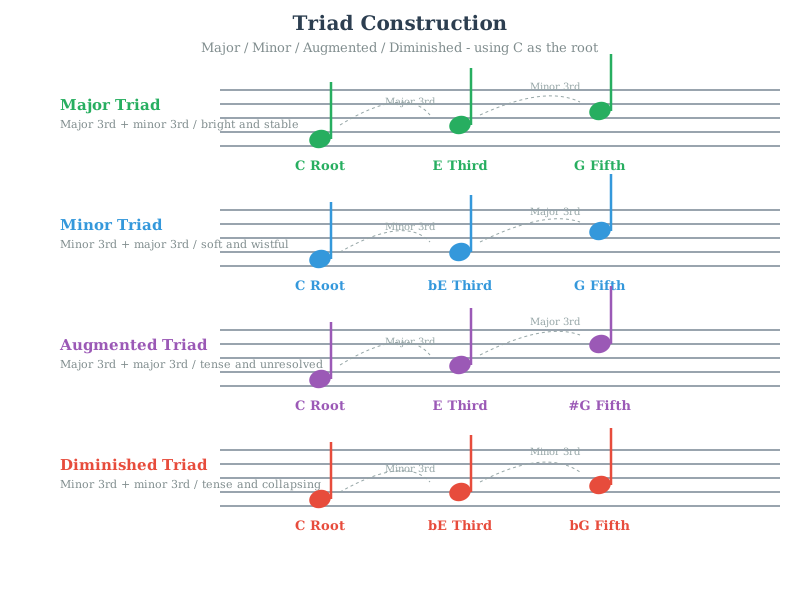
There are four basic triads. Using C as the root for comparison:
- Major triad: Major third + minor third. For example, C-E-G. Sounds bright and stable.
- Minor triad: Minor third + major third. For example, A-C-E. Sounds gentle and wistful.
- Augmented triad: Major third + major third. For example, C-E-#G. Sounds tense and unresolved.
- Diminished triad: Minor third + minor third. For example, B-D-F. Sounds urgent and collapsing inward.
Inversion moves the root out of the bass: putting the third in the bass gives a first inversion, putting the fifth in the bass gives a second inversion. The rule of thumb is to identify the bass note first, then rearrange the upper notes in your mind. Once you internalize this, your reading speed doubles.
11. Seventh Chords: Four-Note Color Wheels
Add a seventh on top of a triad and you get a seventh chord, four notes stacked in thirds. Seventh chords are the main seasoning of harmony.
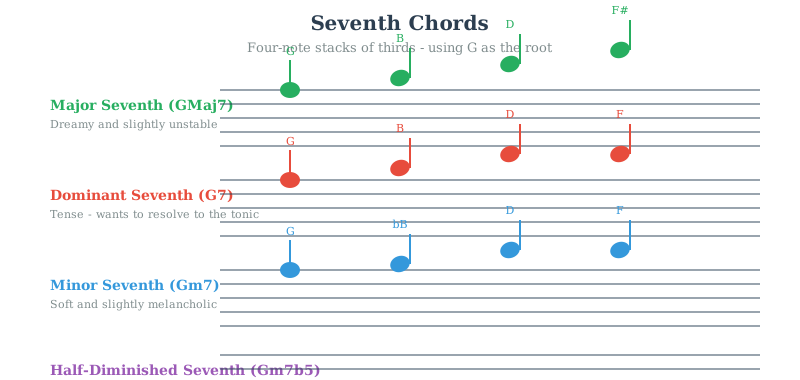
Common types, using G as the root:
- Major seventh (GMaj7): Major triad + major seventh. G-B-D-F#. Sounds dreamy and slightly unstable.
- Dominant seventh (G7): Major triad + minor seventh. G-B-D-F. The classic "tension that wants to resolve" chord in pop and jazz.
- Minor seventh (Gm7): Minor triad + minor seventh. G-Bb-D-F. Sounds soft, slightly melancholy.
- Half-diminished seventh (Gm7b5): Diminished triad + minor seventh. G-Bb-Db-F. Tense and bruised, common in jazz.
- Diminished seventh: Diminished triad + diminished seventh. Symmetrical and eerie, often used as a passing chord.
- Augmented major seventh: Augmented triad + major seventh.
- Minor major seventh: Minor triad + major seventh. The signature "rainy day" jazz color.
Take the dominant seventh built on G (G7) in the key of C major. It pulls strongly toward C, which is the source of the famous "V-I" progression that gives pop choruses their feeling of "coming home." Learn this one move and you have already decoded half of the harmony in every pop song you have ever heard.
12. Putting It All Together: A Three-Step Roadmap
Basic music theory is not music school homework. It is a language that describes how music sounds to your ears. The fastest way to internalize it follows three steps:
- Recognize. Be able to identify a clef, a time signature, and an accidental at a glance.
- Listen. When a song plays, notice the semitone and whole-tone movement, the strong and weak beats, and whether the chord underneath feels bright, dark, or tense.
- Apply. When you play, sing, or compose, consciously use what you have recognized and listened for.
Theory will not turn you into a performer overnight. But it will change the way you listen. Instead of just "liking" a song, you will be able to explain why it works, and that is the most rewarding payoff of learning basic music theory.
Frequently Asked Questions
How long does it take to learn basic music theory?
Most beginners cover the essentials (notes, clefs, accidentals, time signatures, and simple triads) in about 6 to 12 weeks of regular study. Becoming fluent takes longer, but you can start applying theory to your playing within the first month.
Do I need to read sheet music to learn basic music theory?
No. Theory can be taught by ear, by piano, by guitar, or by humming. Reading notation is one tool among many. The concepts (intervals, rhythm, harmony) are independent of any single instrument or notation system.
Is basic music theory useful for singers?
Absolutely. Singers use theory constantly for pitch matching, interval recognition, and ensemble blend. Understanding scales and chord progressions helps you anticipate where a melody is going and sing in tune.
What is the difference between basic music theory and harmony?
Theory is the whole framework: notes, rhythm, scales, chords, form. Harmony is one branch of that framework, dealing specifically with how notes sound together. You cannot fully study harmony without first learning the rest of basic theory.
Should I learn music theory on the piano or on my main instrument?
The piano is the most efficient instrument for visualizing theory because every pitch is laid out clearly. But if you play another instrument, work with the music theory tools designed for that instrument. Either path works as long as you keep applying what you learn.
Conclusion
Basic music theory gives you a vocabulary for the music you already love. Start with the building blocks in this guide: how sound works, the seven letter names, the clefs and accidentals that organize pitch on the staff, the semitones and whole tones that power every scale, the rhythm and time signatures that drive every song, and the triads and seventh chords that create harmony. Recognize them, listen for them, and apply them, and you will hear music differently for the rest of your life.